When Do You Need to Hire a Construction Superintendent in NYC?
If you are planning construction in New York City, you may hear your architect, contractor, or DOB filing representative say:
“This project requires a Construction Superintendent.”
For many property owners, that immediately creates two questions:
What exactly does a Construction Superintendent do, and when is one actually required?
A Construction Superintendent, often abbreviated as CS, is not simply another person added to the project team. On certain New York City construction and demolition projects, a registered Construction Superintendent is required by the NYC Building Code to provide construction-site oversight and help maintain compliance with safety requirements and approved construction documents.
The requirement depends primarily on the type and scope of construction, not simply how much the project costs.
Understanding the requirement early can help avoid permit delays, incorrect DOB filings, or problems after construction begins.
This guide explains when you may need to hire a Construction Superintendent in NYC and how the role fits into the overall construction process.
What Is a NYC Construction Superintendent?
A Construction Superintendent is an individual registered with the New York City Department of Buildings (DOB) who is assigned responsibility for specific construction-site duties established by the NYC Construction Codes.
The superintendent is involved primarily with construction execution and site safety, not architectural design.
Typical responsibilities include:
- Monitoring job-site conditions
- Helping maintain a safe construction site
- Reviewing construction activities
- Checking that work generally follows approved documents
- Identifying and addressing unsafe conditions
- Maintaining required site-safety documentation
- Coordinating with contractors and responsible project personnel
- Performing required site visits or site presence depending on the project
A Construction Superintendent should not be confused with the architect or engineer responsible for preparing the design.
If your project requires drawings and agency approval, the design and filing process is generally coordinated separately through architectural plans and DOB filing services.
When Is a Construction Superintendent Required in NYC?
Section 3301.13 of the current NYC Building Code identifies several categories of work that require a primary Construction Superintendent.
The requirement should always be reviewed against the specific project, but the major triggers include the following.
1. Construction of a New Building
A Construction Superintendent is generally required when constructing a new building.
This applies whether the new building is residential, commercial, community-facility, or another occupancy, subject to the applicable code provisions and exceptions.
New construction involves significant safety responsibilities, including excavation, structural work, temporary protection, material handling, and coordination among multiple trades.
For that reason, the superintendent becomes an important part of the site-safety structure.
There is an important exception for qualifying one-, two-, and three-family buildings, which we will discuss later.
2. Full Demolition of an Existing Building
A full building demolition generally requires a Construction Superintendent.
Demolition can present substantial hazards to workers, neighboring properties, pedestrians, and existing structures.
The superintendent’s role becomes especially important because demolition conditions can change rapidly as portions of the building are removed.
Demolition work may also involve requirements related to:
- Sidewalk protection
- Adjacent buildings
- Dust and debris
- Temporary bracing
- Structural stability
- Site access
- Safety zones
- Equipment operation
Before demolition begins, the DOB application, permits, required plans, and site-safety requirements should be properly coordinated.
HN Republic provides NYC DOB permit expediting and filing coordination for projects moving through the approval and permitting process.
3. Vertical Enlargement
A vertical enlargement adds building area upward.
Examples might include:
- Adding another story
- Constructing a rooftop addition
- Increasing the height of an existing building with new occupied floor area
Because vertical enlargements can involve structural modifications, temporary support, fall hazards, and significant construction activities, the NYC Building Code lists vertical enlargement as one of the conditions requiring a Construction Superintendent.
Before considering an enlargement, the project team should also determine whether the additional floor area and height are permitted under zoning.
A NYC zoning and building-code analysis can help determine whether the proposed enlargement complies with FAR, building height, setbacks, yards, lot coverage, and other zoning restrictions.
4. Horizontal Enlargement
A horizontal enlargement expands an existing building outward.
Common examples include:
- Rear extensions
- Side additions
- Expanding a commercial building
- Increasing the footprint of a residential building
Like vertical enlargements, horizontal enlargements are among the construction activities that may require a Construction Superintendent.
Even a relatively modest extension can involve excavation, foundations, structural work, underpinning, or protection of neighboring property.
This is why owners should not determine superintendent requirements simply by looking at the physical size of the addition.
5. Alteration or Demolition of More Than 50% of the Building’s Gross Floor Area
A project does not need to be a complete building demolition to trigger the superintendent requirement.
Under the NYC Building Code, alteration or demolition involving more than 50 percent of the gross floor area of the building during a 12-month period can require a Construction Superintendent.
This can become relevant during major gut renovations.
Imagine an owner renovating most of a five-story building.
The exterior structure may remain, but interior partitions, finishes, ceilings, systems, and other components throughout most of the building are being demolished and reconstructed.
Even though the project is technically an alteration rather than a new building, its scale can trigger additional site-safety requirements.
6. Removal of One or More Floors
Removing an entire floor is another specific trigger.
This does not simply mean removing the flooring finish.
It generally concerns removal of an actual building floor as part of structural alteration or demolition.
Structural floor removal can significantly affect building stability and construction sequencing, which is why additional site supervision is required.
7. Work Requiring Underpinning
Underpinning is frequently encountered in New York City because buildings are often constructed extremely close to one another.
If a proposed excavation extends below the foundation of an adjacent structure, additional engineering and protection may be necessary.
Where work requires a special inspection for underpinning, the Construction Superintendent requirement can be triggered.
Underpinning should never be treated as ordinary construction.
It can affect:
- Existing foundations
- Neighboring structures
- Excavation safety
- Structural stability
- Property-line conditions
- Monitoring requirements
Architects and engineers should identify these conditions during design so the contractor can understand the required site-safety team before construction begins.
8. Protection of the Sides of Excavations
Construction involving excavation can also require a Construction Superintendent when a special inspection for protection of the sides of excavations is required.
Excavation presents significant risks because unsupported soil can move or collapse.
Depending on the project, protection may involve systems such as shoring, bracing, sheeting, or other engineered excavation-support methods.
This is another example of why a project that appears simple on architectural plans may have much more significant construction-safety requirements once structural and excavation work is considered.
The Special Rule for 1-, 2-, and 3-Family Buildings
There is an important exception for certain smaller residential buildings.
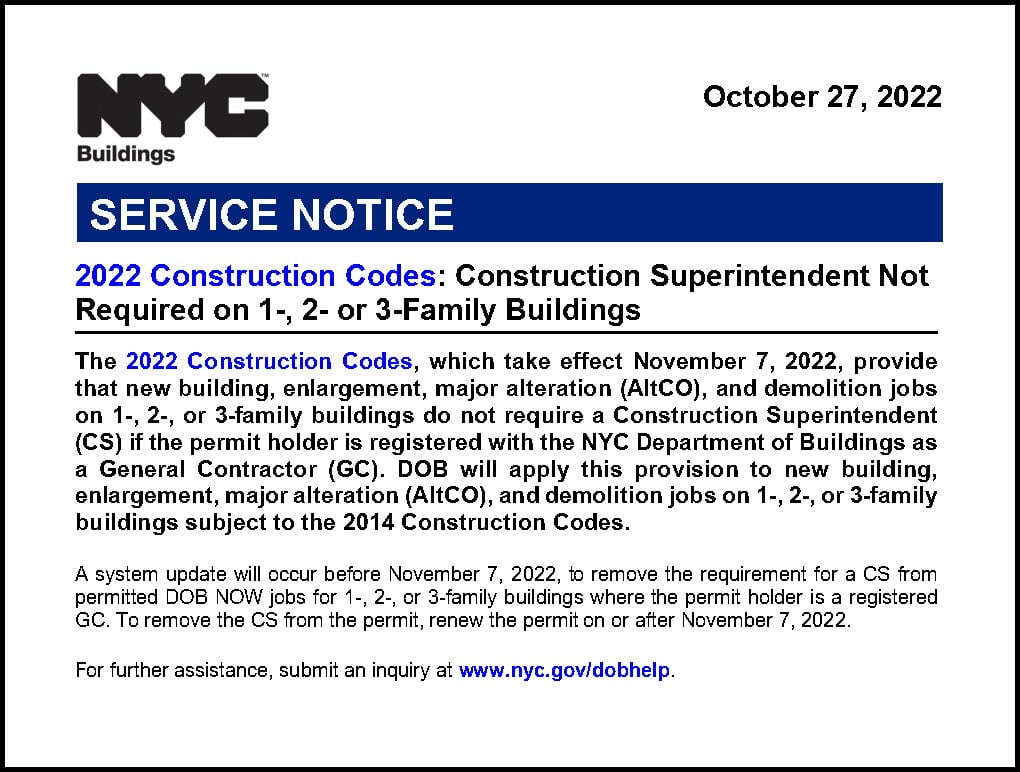
Under the current NYC Building Code, a Construction Superintendent is not required for work that solely involves a one-, two-, or three-family building, or an accessory use to that building, provided the permit holder is properly registered with DOB as a General Contractor under the applicable requirements.
However, the details matter.
DOB’s current DOB NOW guidance explains that the exemption depends on factors including the building type, job type, and status of the registered General Contractor.
For this reason, an owner should not simply assume:
“It’s a two-family house, so I don’t need a superintendent.”
The project and contractor information should be checked before permit issuance.
Construction Superintendent vs. Site Safety Manager
Another common source of confusion is the difference between a Construction Superintendent and a Site Safety Manager or Site Safety Coordinator.
These are different roles.
For certain projects involving a major building, additional site-safety personnel may be required.
Under current NYC rules, a major building generally includes a building that is:
- 10 or more stories;
- 125 feet or more in height; or
- 100,000 square feet or more in building footprint, regardless of height.
For qualifying major-building projects subject to the current code, the project may require both a Construction Superintendent and a Site Safety Manager or Site Safety Coordinator.
Having one does not necessarily eliminate the requirement for the other.
This distinction should be established before construction starts.
What Does the Construction Superintendent Actually Do?
The superintendent is not hired simply so a name can appear on the DOB permit.
The role carries real responsibilities.
The NYC Building Code requires Construction Superintendents to act reasonably and responsibly to maintain job-site safety and help ensure compliance with Chapter 33 requirements.
Their responsibilities can include reviewing the work area, identifying unsafe conditions, ensuring corrective action is taken, reviewing approved project documents, coordinating required safety measures, and maintaining required records.
Depending on the project, the superintendent may also need to visit the site whenever active work occurs or maintain more continuous site presence.
This makes the Construction Superintendent part of the active construction team—not simply an administrative requirement.
When Should You Hire the Construction Superintendent?
Ideally, superintendent requirements should be identified before the contractor applies for the work permit.
Waiting until the permit stage to discover that a CS is required can create delays.
During preconstruction, the project team should determine:
- What work is proposed?
- What DOB application type is being filed?
- Is the project a new building, demolition, enlargement, or major alteration?
- Will excavation or underpinning occur?
- Is the building considered a major building?
- Does a one-, two-, or three-family exemption apply?
- What site-safety documents are required?
- Who will be listed as the Construction Superintendent?
These questions should be coordinated among the architect or engineer, contractor, superintendent, owner, and filing representative.
Can Construction Begin Without the Required Superintendent?
If the Building Code requires a Construction Superintendent, the permit holder must properly designate the superintendent before applicable work begins.
Starting construction without required site-safety personnel can create serious compliance problems.
DOB enforcement can potentially result in violations, Stop Work Orders, penalties, or delays until the required conditions are corrected.
If a project already has DOB or OATH/ECB violations, HN Republic’s DOB and ECB violation resolution services can assist with reviewing the agency record and coordinating the appropriate compliance path.
Construction Superintendent and Project Closeout
Owners often think about the Construction Superintendent only when the permit is being issued.
But construction-site documentation and proper coordination throughout the project can also affect final completion.
A project may eventually need:
- Final inspections
- Special-inspection completion
- Contractor sign-offs
- Technical-report completion
- Resolution of DOB objections
- Permit closeout
- Letter of Completion or Certificate of Occupancy documentation
For projects that remain open after construction, NYC Certificate of Occupancy and project closeout services can help identify outstanding requirements and develop a path toward final sign-off.
Final Thoughts
So, when do you need to hire a Construction Superintendent in NYC?
The answer depends on the construction scope.
A Construction Superintendent is commonly required for:
- New building construction
- Full building demolition
- Vertical enlargements
- Horizontal enlargements
- Alteration or demolition affecting more than 50% of a building’s gross floor area
- Removal of one or more floors
- Work requiring underpinning special inspections
- Work requiring special inspection for protection of excavation sides
- Other work determined by DOB to present an enhanced risk
Certain one-, two-, and three-family projects may qualify for an exception when the permit holder satisfies the applicable DOB General Contractor requirements.
The best approach is to determine the requirement during the design and preconstruction stage, not after the contractor is ready to begin work.
New York City construction involves overlapping responsibilities among owners, architects, engineers, contractors, Construction Superintendents, special inspectors, site-safety professionals, and DOB filing representatives.
Understanding who is responsible for what before construction starts can prevent expensive delays later.
HN Republic assists property owners, contractors, architects, engineers, and developers with architectural plans and DOB filing coordination, DOB permit expediting, zoning and building-code consulting, violation resolution, and project closeout throughout New York City.
Educational Disclaimer
This article is provided for general educational and informational purposes only. Construction Superintendent, site-safety, permitting, licensing, inspection, and supervision requirements depend on the project scope, building type, applicable code, filing date, permit conditions, and current NYC Department of Buildings requirements. This article should not be interpreted as legal, engineering, architectural, or construction-safety advice. Project-specific requirements should be confirmed with the appropriate registered professionals, contractors, safety professionals, and NYC Department of Buildings.