DOB NOW vs. DOB BIS: Which NYC Building System Should You Use?
If you have ever searched for a New York City building permit, violation, complaint, or construction application, you have probably encountered two different systems: DOB NOW and the Buildings Information System, better known as DOB BIS or BISWeb.
Why does New York City have both?
The short answer is that the Department of Buildings is moving from an older record system to a newer digital platform. However, the transition is not complete. Older applications and permits may remain in BIS, while newer filings are generally managed through DOB NOW.
For a complete review of a property, you will often need to check both systems.
This guide explains what DOB NOW and DOB BIS contain, which system to use for different searches, and how to avoid missing important information about a New York City property.
The Difference Between DOB NOW and BIS in One Minute
Think of the two systems this way:
DOB BIS is primarily a legacy building-record system. It is especially useful for older job applications, permits, complaints, violations, occupancy information, and property history.
DOB NOW is the Department’s current digital filing and project-management platform. It is used for many newer applications, permits, payments, objections, inspections, compliance filings, and project closeouts.
DOB NOW has not made BIS irrelevant. According to the NYC Department of Buildings, jobs filed in DOB NOW: Build do not appear in BIS. The Department recommends using both systems when researching all filings and permits associated with an address.
DOB NOW vs. DOB BIS: Quick Comparison
| Feature | DOB BIS / BISWeb | DOB NOW |
|---|---|---|
| Main purpose | Researching legacy building and job records | Filing and managing newer DOB applications |
| Best for | Older permits, applications, complaints, violations, occupancy records and property history | Current filings, objections, payments, permits, inspections and compliance submissions |
| Public search | Yes | Yes, through the DOB NOW Public Portal |
| Account required | Generally not for public searches | Not for public searches; an NYC.ID account is required to participate in filings |
| Active project workflow | Limited and connected mainly to legacy jobs | Yes; designed for active digital filing and coordination |
| Does it contain every DOB record? | No | No |
| Should it be checked during due diligence? | Yes | Yes |
The safest rule is simple: if the information could affect a purchase, renovation, refinancing, tenant occupancy, or property closing, search both platforms.
What Is NYC DOB BIS?
The NYC Buildings Information System, commonly called BIS or BISWeb, is the Department of Buildings’ older public database.
BIS provides a property profile for buildings throughout New York City. Depending on the property and available records, you may find:
Legacy job applications
Older work permits and permit renewals
Complaints
DOB violations
OATH/ECB-related information
Certificate of Occupancy information
Building characteristics and occupancy details
Plumbing, elevator, boiler, or equipment records
Inspection and enforcement history
Licensed contractor and tradesperson information
BIS is especially important when reviewing an older building. A property may have decades of permit, occupancy, and enforcement history that does not appear in DOB NOW.
For example, a new apartment renovation may be filed in DOB NOW, while a 1990s alteration, an old complaint, and the building’s historical Certificate of Occupancy remain in BIS.
The City’s Find Building Data guide confirms that BIS contains permits and job applications created before the launch of DOB NOW.
What Is DOB NOW?
DOB NOW is the Department of Buildings’ newer online platform. It allows owners, architects, engineers, contractors, licensees, inspectors, and filing representatives to complete many DOB transactions digitally.
Instead of relying on paper submissions and repeated visits to a borough office, project participants can use DOB NOW to:
Create and submit job filings
Upload plans and supporting documents
Pay filing and permit fees
Review application status
Receive and respond to objections
Schedule certain appointments and inspections
Pull and print eligible permits
Submit amendments and corrections
Track compliance filings
Request project closeout documents
Receive notifications as an application moves through review
The Department describes the platform in its official DOB NOW overview.
The Main DOB NOW Modules
DOB NOW is not a single application screen. It contains several modules designed for different types of work.
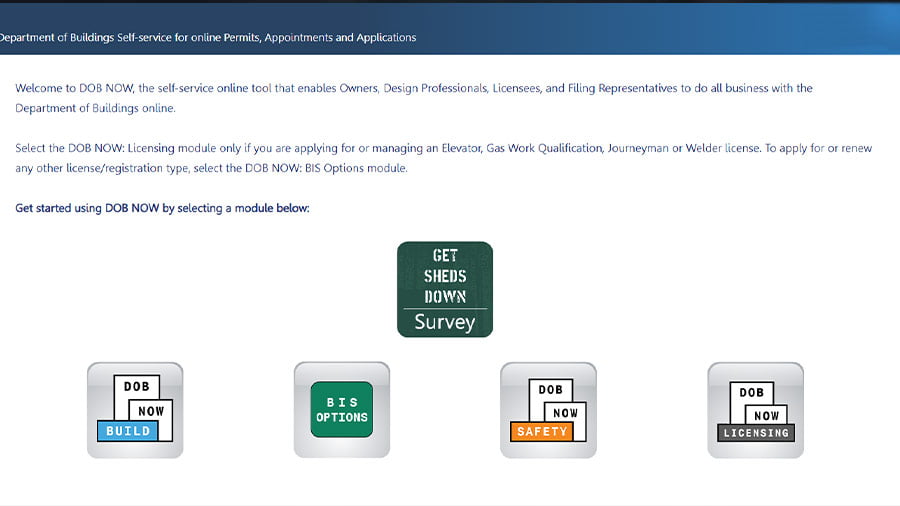
DOB NOW: Build
DOB NOW: Build is used for many current construction filings, including new buildings, alterations, limited alterations, demolition, plumbing, mechanical work, structural work, cranes, signs, and other application types.
The exact filing route depends on the project, building, work type, and any special circumstances. Our guide on how to get a building permit in NYC explains the broader permit process.
DOB NOW: Safety
DOB NOW: Safety handles various building-compliance filings. Depending on the applicable requirements, these may include façade, boiler, elevator, energy, parking-structure, and gas-piping compliance.
DOB NOW: Inspections
This system is used to request and track many development and enforcement inspections. The available inspection types depend on the job and work category.
DOB NOW: Licensing
DOB NOW: Licensing is used for applications, renewals, and management of many DOB-issued licenses and registrations.
DOB NOW: BIS Options
The name can be confusing. BIS Options is accessed through DOB NOW, but it supports selected transactions associated with legacy records or processes. These can include records requests and certain correction, penalty, or licensing-related submissions.
The existence of BIS Options does not mean that every BIS job has been transferred into DOB NOW.
Does DOB NOW Replace BIS?
Not yet.
The DOB states in its Public Portal FAQs that the public portal may eventually replace BIS, but not until all transactions have transitioned.
For now:
BIS information continues to be maintained.
DOB NOW: Build jobs do not appear as BIS jobs.
Legacy filings may remain available only through BIS and related systems.
Newer filings are generally found through the DOB NOW Public Portal.
A full property review may require BIS, DOB NOW, and sometimes NYC Open Data.
This is why searching only one system can produce an incomplete picture.
When Should You Use DOB BIS?
Start with BIS when you need to:
Research an older building’s history
Locate a legacy job or permit
Review older complaints or violations
Check historical occupancy information
Find an older Certificate of Occupancy
Investigate an open or expired legacy permit
Review records before purchasing a property
Understand whether past work may affect a new application
Continue or close a job created through the older filing process
If you discover an unresolved legacy application, read our guide to closing an open DOB permit in NYC.
When Should You Use DOB NOW?
Use DOB NOW when you need to:
Find a newer construction filing
Follow an application through plan review
Review DOB objections
Upload required documents
Make a payment
Pull an eligible permit
File a Post Approval Amendment
Schedule or track inspections
Review a compliance filing
Obtain or track a Letter of Completion
Coordinate an active filing among the owner, applicant and contractor
Finishing construction does not automatically close the DOB application. Our detailed guide explains the requirements for obtaining a DOB Letter of Completion.
How to Search a NYC Property Correctly
A careful property search should follow several steps.
1. Gather the property identifiers
Start with the street address. If possible, also obtain:
Borough
Block and lot, commonly called the BBL
Building Identification Number, or BIN
DOB job or application number
Violation or summons number
Searching by BIN or BBL can be more reliable than searching only by street address. One building can have multiple addresses, and an address may have been written differently in older records.
2. Search DOB BIS
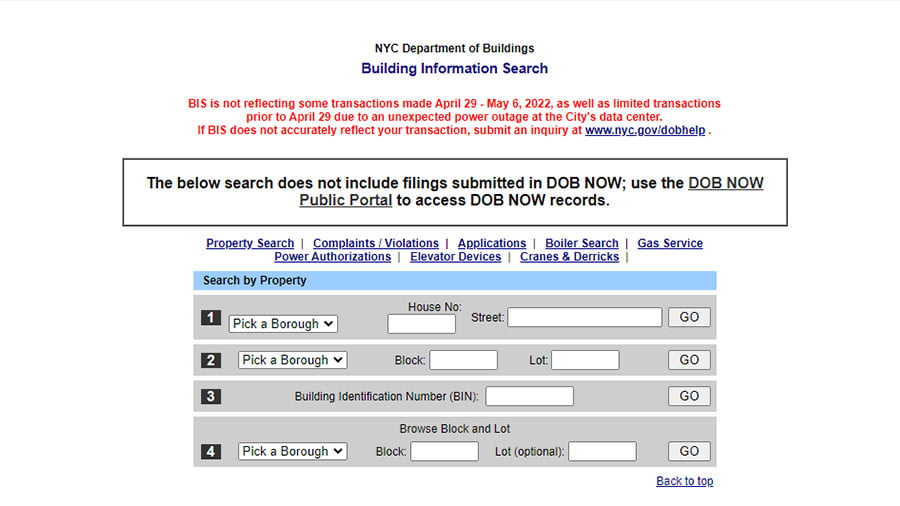
Open BISWeb and review the property profile, job applications, permits, complaints, violations, inspections, occupancy information, and available Certificates of Occupancy.
Do not stop at the first screen. Open the individual job and permit records to understand their status.
3. Search the DOB NOW Public Portal
Use the DOB NOW Public Portal to search newer filings by address, BBL, BIN, job number, device, licensee, or violation category.
You do not need to log in for basic public searches. An NYC.ID account is needed when you must participate in a filing, sign documents, or complete transactions.
4. Compare the two systems
Look for records that may be connected across different generations of the property’s history.
For example:
Does an old BIS job affect the scope of the new DOB NOW filing?
Does the existing layout match the Certificate of Occupancy?
Are there open permits or violations?
Was a previous application approved but never signed off?
Are required inspections still outstanding?
5. Use NYC Open Data when necessary
The NYC Open Data portal can be useful for broader searches, downloadable datasets, and comparing records across multiple properties. However, a database result should still be reviewed alongside the original DOB record.
Common Mistakes When Searching DOB Records
Searching only DOB NOW
A clean DOB NOW search does not prove that the property has no older problems. Legacy permits, complaints, violations, or occupancy records may still be in BIS.
Searching only BIS
The opposite problem also occurs. A BIS search may not show a newer renovation, permit, compliance filing, or Certificate of Occupancy issued through DOB NOW.
Assuming “approved” means “permitted”
Application approval and permit issuance are different milestones. Additional fees, insurance, contractor information, documents, or required actions may need to be completed before a permit can be pulled.
Assuming completed construction means a closed job
Physical completion does not automatically close the application. Final inspections, technical reports, cost documentation, sign-offs, or a Letter of Completion may still be required.
Ignoring an old application because it is inactive
An old application can still matter during a sale, refinancing, legalization project, or new renovation. It may also reveal the approved scope of earlier work.
Treating every violation the same way
Different violations have different correction and certification procedures. Some information may be found in BIS, while certain compliance violations appear through DOB NOW: Safety. Learn more about NYC DOB violations and how they are corrected.
Why Checking Both Systems Matters Before Buying or Renovating
A proper DOB record review can uncover conditions that are not obvious during a physical walkthrough, including:
Open or expired permits
Unresolved violations
Work that was approved but never signed off
A layout that may not match approved records
A Certificate of Occupancy that does not match the proposed use
An older application affecting the new filing
Required inspections or closeout documents
Restrictions that could delay construction or a closing
Finding these issues early gives the owner, buyer, architect, or attorney time to evaluate the cost and possible resolution.
A database search is an important starting point, but it is not a substitute for reviewing the actual documents and existing building conditions.
When Professional Help May Be Useful
You may want professional assistance if:
You cannot determine which record controls
BIS and DOB NOW show conflicting information
A permit or application has remained open for years
The current layout does not appear to match DOB records
You need to legalize unpermitted work
An active filing is stalled by objections or missing documents
A closing or construction start date is approaching
Several violations or applications are connected
DOB expediting is not a way to bypass Department requirements. It is the process of organizing filings, coordinating project participants, tracking agency actions, and reducing preventable delays.
HN Republic provides DOB permit and filing support for owners, contractors, and design teams. We also assist with DOB and ECB violation resolution.
Final Answer: Should You Use DOB NOW or BIS?
In many cases, you should use both.
Use DOB BIS to understand the building’s legacy history. Use DOB NOW to research and manage newer filings and digital workflows. When a property has a long construction history, the two systems often tell different parts of the same story.
If you need help reviewing a property, send HN Republic the address, BIN or BBL, known job numbers, and any violation notices. Contact our team to discuss the records and the appropriate next steps.
Frequently Asked Questions
Is DOB BIS still active?
Yes. BIS continues to provide important legacy building, application, permit, complaint, violation, and occupancy records. It remains necessary while the City continues transitioning transactions to DOB NOW.
Do DOB NOW jobs appear in BIS?
No. The Department states that jobs filed in DOB NOW: Build do not appear as jobs in BIS. Search the DOB NOW Public Portal for those filings.
Can I search DOB NOW without an account?
Yes. Basic searches can be performed through the public portal without logging in. An NYC.ID account is required to sign, submit, or participate in applications and transactions.
Which system should I use to check NYC building permits?
Check both. Use BIS for legacy permits and DOB NOW for permits connected to newer digital filings.
Where should I search for NYC DOB violations?
Search both BIS and the DOB NOW Public Portal. The correct location depends on the violation type and when it was issued.
Can an old BIS job affect a new DOB NOW application?
Yes. Earlier work, occupancy records, unresolved permits, violations, or approved conditions can affect the review and closeout of a newer project.
What is the best way to search a building with multiple addresses?
Search by BIN or BBL when possible. These identifiers can provide more complete results than relying on one street address.
Does an open DOB permit mean there is a violation?
Not automatically. An open permit and a violation are different records. However, an unresolved permit can still create complications during later construction, refinancing, or a property transaction.