
How to Obtain a DOB Letter of Completion in NYC
Finishing construction does not automatically close a permit in New York City. Even when the contractor has completed every visible part of the project, the related application may remain open in the records of the New York City Department of Buildings. To properly close many alteration projects, the required inspections, technical reports, documents, and permit sign-offs must be completed before the Department will issue a Letter of Completion.
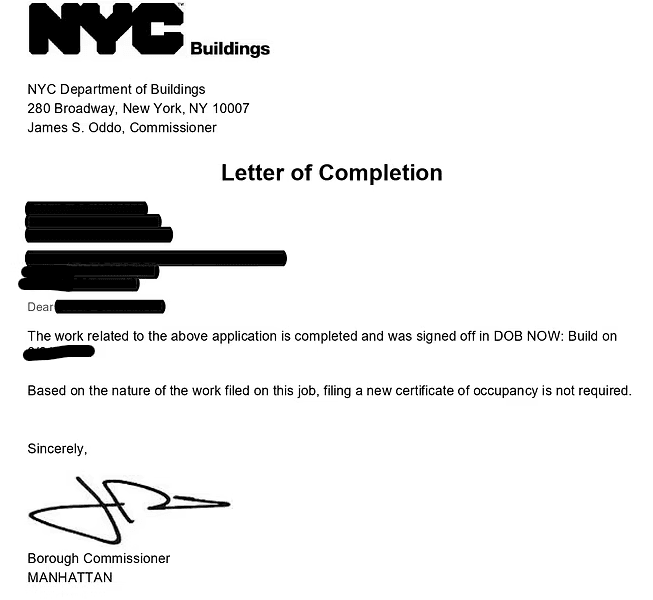
A DOB Letter of Completion—commonly called an LOC—is an official record confirming that an eligible construction application has reached the required level of completion and closeout. It is generally issued for alteration work that does not require a new or amended Certificate of Occupancy.
Obtaining this letter is important because an open application can create complications during a property sale, refinancing, future renovation, insurance review, or building compliance investigation. Understanding the closeout process early can help owners avoid discovering an unresolved permit years after the contractor has left the project.
This guide explains how to obtain a DOB Letter of Completion in NYC, including the differences between DOB NOW and legacy BIS applications, common reasons for delays, and the steps property owners can take to protect their building records.
What Is a DOB Letter of Completion?
A Letter of Completion is issued by the NYC Department of Buildings after an eligible construction job has satisfied the applicable closeout requirements. These requirements may include final inspections, contractor sign-offs, certified technical reports, completed special inspections, final construction costs, and supporting documentation.
The letter does not replace a Certificate of Occupancy. Instead, it documents the completion of work performed under an application that generally did not change the building’s legal use, egress, or occupancy in a way that requires a new or amended Certificate of Occupancy.
Examples of projects that may qualify for a Letter of Completion include:
Interior renovations
Nonstructural partition work
Certain plumbing alterations
Mechanical-system work
Sprinkler or standpipe modifications
Façade repairs
Structural repairs
Storefront modifications
Other alterations that do not require a new or amended Certificate of Occupancy
The exact requirements depend on the application, work types, approved plans, permit history, applicable code, and inspections identified by DOB.
According to the Department’s Letter of No Objection or Completion guidance, project closeout does not end with the physical construction. The contractor, design professional, special inspection agencies, and property owner must ensure that the necessary inspections and sign-offs are completed.
Letter of Completion vs. Certificate of Occupancy
A Letter of Completion and a Certificate of Occupancy serve different purposes.
A Certificate of Occupancy identifies a building’s legal use, permitted occupancy, and other occupancy-related information. New buildings require a Certificate of Occupancy, and an existing building may require a new or amended CO when a project changes its use, egress, or type of occupancy.
A Letter of Completion is typically associated with a more limited alteration that does not require changing the Certificate of Occupancy.
For example, renovating an office while maintaining the same legal use and occupancy may be eligible for an LOC. Converting that office into residential apartments would ordinarily involve a change in use or occupancy and may require an Alteration-CO application and an amended Certificate of Occupancy.
The application type and approved scope—not merely the project’s size or cost—determine which completion document is required.
A Letter of Completion should also not be confused with a Letter of No Objection. A Letter of No Objection may be requested in certain cases to establish the accepted legal use of an older building that does not have a Certificate of Occupancy. It is not a project closeout document.
Why Is a Letter of Completion Important?
An open DOB job can remain visible in the property’s public record even after construction has been completed. This may raise questions about whether the work passed inspection, complied with approved plans, or was ever formally accepted by DOB.
An unresolved application may affect:
A property sale or closing
Mortgage refinancing
Title and due-diligence reviews
Future DOB permit applications
Insurance underwriting
Cooperative or condominium approvals
Violation resolution
Legalization of other work
A future Certificate of Occupancy application
Open permits do not all create the same level of risk. Nevertheless, they should be investigated rather than ignored. Owners can learn more in HN Republic’s guide to closing an open DOB permit in NYC.
Obtaining the LOC provides documented evidence that the related eligible application was properly closed. It can also make the property’s regulatory history clearer for buyers, lenders, attorneys, architects, and future contractors.
Step 1: Identify Whether the Job Is in DOB NOW or BIS
The first step is determining where the application is recorded.
Newer applications are generally managed through DOB NOW: Build. Many older applications remain in the legacy Building Information System, commonly known as BIS. The closeout procedure differs depending on which system controls the job.
Owners should search the property address and review:
The job or application number
Filing and job status
Approved work types
Permit status
Required items
Inspection records
Applicant and contractor information
Open objections or audit conditions
Post Approval Amendments
Related applications
DOB NOW filings can be researched through the DOB NOW Public Portal, while older job records may be available through BIS Property Search.
For a more detailed comparison, read HN Republic’s explanation of DOB NOW versus DOB BIS.
Step 2: Confirm That the Completed Work Matches the Approved Plans
Before requesting final sign-off, the owner and project team should confirm that the actual construction matches the approved DOB drawings and scope of work.
If the project contains substantive changes, the applicant of record may need to file a Post Approval Amendment, often called a PAA. For certain non-substantive changes, revised as-built drawings may be required before project sign-off.
The Department’s project sign-off and completion guidance specifically notes that substantive changes require a PAA, while certain non-substantive field changes may be addressed through as-built drawings.
Attempting to close an application when the constructed conditions do not match the approved plans may result in failed inspections, objections, or additional filings. If work was performed outside the approved scope—or without the required permit—a separate legalization application may be necessary.
Step 3: Complete All Required Inspections
Every permit associated with a DOB NOW filing must generally receive the required final inspection or certified final technical report before the application can qualify for an LOC.
Depending on the scope, closeout may involve:
Final construction inspection
Plumbing inspection
Mechanical inspection
Sprinkler or standpipe inspection
Electrical completion
Special inspections
Progress inspections
Energy-code inspections
Fire-stopping inspections
Structural inspections
Other project-specific requirements
Required Department inspections are generally scheduled through DOB NOW: Inspections. Where permitted, a contractor may self-certify certain inspections, subject to DOB rules and possible audit.
A common mistake is assuming that passing the main construction inspection closes every work type. If the filing includes construction, plumbing, mechanical, and sprinkler work, the applicable permits and inspection requirements must each be reviewed. One unsigned permit may prevent issuance of the Letter of Completion.
Step 4: Certify Special Inspections and Technical Reports
Many projects require special or progress inspections performed by registered Special Inspection Agencies. These inspections may cover structural stability, concrete, masonry, fire-resistant penetrations, energy-code compliance, mechanical systems, or other regulated work.
Completing the inspection in the field is not enough. The responsible agency must also submit or certify the result in the DOB system.
Before requesting an LOC, verify that:
Every required inspection has been performed
No inspection remains incomplete
Final technical reports have been certified
The appropriate professional has submitted the certification
Any rejected or incomplete report has been corrected
Old jobs sometimes remain open because the original special inspection agency, contractor, or applicant is no longer available. In that situation, the owner may need professional assistance to determine whether a replacement, withdrawal, or superseding procedure is available.
Step 5: Resolve Open Required Items and Administrative Issues
A project may pass its inspections but still fail to qualify for an LOC because of administrative deficiencies.
Common unresolved items include:
Missing forms or supporting documents
Open required items
Unpaid DOB fees
Unresolved audit conditions
Incomplete Post Approval Amendments
Missing TR forms
Missing contractor sign-offs
Incomplete Statements and Signatures
Permit-status problems
Final-cost verification errors
Review the application record carefully. The information needed for closeout is often distributed across several sections rather than presented in one simple checklist.
If an open DOB or OATH/ECB violation is connected to the project, determine whether it must be resolved before the LOC can be processed. HN Republic’s DOB and ECB violation-removal services explain how violations can interfere with permits, transactions, and construction closeout.
Step 6: Verify the Final Construction Cost
For DOB NOW applications, the Cost Affidavit or PW3 final-cost information must be completed and verified before an LOC request can be submitted.
Even when the final construction cost is identical to the estimated cost, DOB requires the Final Cost Details section to be completed correctly. The Department’s DOB NOW: Build FAQs explain that users must add the relevant work category, description, and cost details rather than merely indicate that the amount did not change.
Incorrect or incomplete cost information is a relatively small issue, but it can prevent the system from accepting the LOC request.
Step 7: Submit the Letter of Completion Request
Requesting an LOC for a DOB NOW Job
For a DOB NOW filing, the owner or applicant of record may request the Letter of Completion after the application reaches Permit Entire status and the other applicable requirements have been satisfied.
From the DOB NOW dashboard, the authorized user can generally select “+Requests” and then “Letter of Completion,” or choose “Request LOC” from the Filing Action column.
Before submission, confirm that:
The application is in Permit Entire status
All required permits have been issued
Every applicable permit is signed off
Final technical reports are certified
All documents have been submitted
Final costs are verified
After-hours variance permits, if any, have the required status
After DOB approves the request, the Letter of Completion becomes available through the DOB NOW Public Portal. It can generally be located by searching the address or job number, opening the job filing, selecting “Letter of Completion,” and choosing the View/Print option.
Requesting an LOC for a BIS Job
For an older BIS application, the process is different. The requestor generally must complete the PW7 Letter of Completion Request form and upload it through eSubmit in DOB eFiling.
The submission should identify:
Form Name: PW7
Request Type: LOC
If BIS shows missing required items, those documents generally must also be uploaded for the request to proceed. A folder review may reveal additional deficiencies, including missing inspections, unpaid fees, incomplete PAAs, TR1 errors, open violations, or audit conditions.
Legacy applications can be particularly challenging because the physical project may have been completed many years ago while documents or sign-offs remain missing.
Common Reasons a DOB Letter of Completion Is Delayed
The most frequent causes of LOC delays include:
One or more permits were never signed off.
A special inspection was performed but not certified.
Construction does not match the approved plans.
A required PAA was never completed.
Final construction costs were not properly entered.
A supporting form or required item is missing.
The original contractor or applicant is no longer available.
An old permit expired before receiving final inspection.
Work exceeded the approved scope.
The request was submitted through the wrong system.
An experienced filing representative or design professional can review the record, identify the blocking items, and create a closeout strategy. HN Republic provides NYC DOB expediting and permit services, including application research, inspection coordination, corrections, sign-offs, and permit closeout support.
Frequently Asked Questions
How long does it take to obtain a DOB Letter of Completion?
The timeline depends on the condition of the application. A complete job with signed-off permits and certified reports may move relatively efficiently. An old application with missing inspections, unavailable professionals, plan discrepancies, or unresolved violations may require substantially more time.
Can a property owner request the Letter of Completion?
For a DOB NOW job, the Department states that the owner or applicant of record can request the LOC after the filing meets the required conditions. BIS requests generally use the PW7 process through eSubmit.
Does an LOC prove the legal occupancy of a building?
Not necessarily. Legal use and occupancy are generally established through the Certificate of Occupancy or, in qualifying older buildings, potentially a Letter of No Objection. An LOC primarily documents the completion of an eligible alteration application.
Can an expired permit still receive an LOC?
An expired permit does not automatically mean that an LOC is impossible, but additional steps may be required. The permit may need to be renewed or otherwise addressed before inspection and sign-off. The correct solution depends on the application history and current site conditions.
Can DOB issue an LOC if the work differs from the approved plans?
Plan discrepancies should be addressed before closeout. A PAA, as-built drawings, or a new legalization application may be required, depending on the nature and extent of the changes.
Final Thoughts
Obtaining a DOB Letter of Completion is the final administrative step that turns a physically completed alteration into a properly closed DOB application. The process requires more than submitting a single request. Every permit, inspection, technical report, required item, cost affidavit, and plan condition must be reviewed as part of the complete project record.
Property owners should begin planning for closeout before construction ends. Confirm the required inspections, maintain communication with the contractor and design professional, preserve project records, and verify that field conditions match the approved plans. Taking these steps early is far easier than attempting to reconstruct the project history years later.
If your application remains open, HN Republic can research the DOB record, identify missing requirements, coordinate with the responsible professionals, and assist with the path toward final sign-off. Contact HN Republic to discuss a DOB NOW or BIS application requiring a Letter of Completion in New York City.