Remote Work and Cabin Fever: The Hidden Challenge for Architects
Hamoun Niknejad2026-09-06T16:43:05+00:00For many professionals, working from home means flexibility, fewer commutes, more control over the day, and the ability to focus without constant office interruptions. An architect can open a laptop in the morning, review drawings, answer emails, join a Zoom meeting, revise a Revit model, research the building code, and communicate with consultants without ever leaving home.
From a productivity standpoint, that can sound ideal.
But there is another side to it.
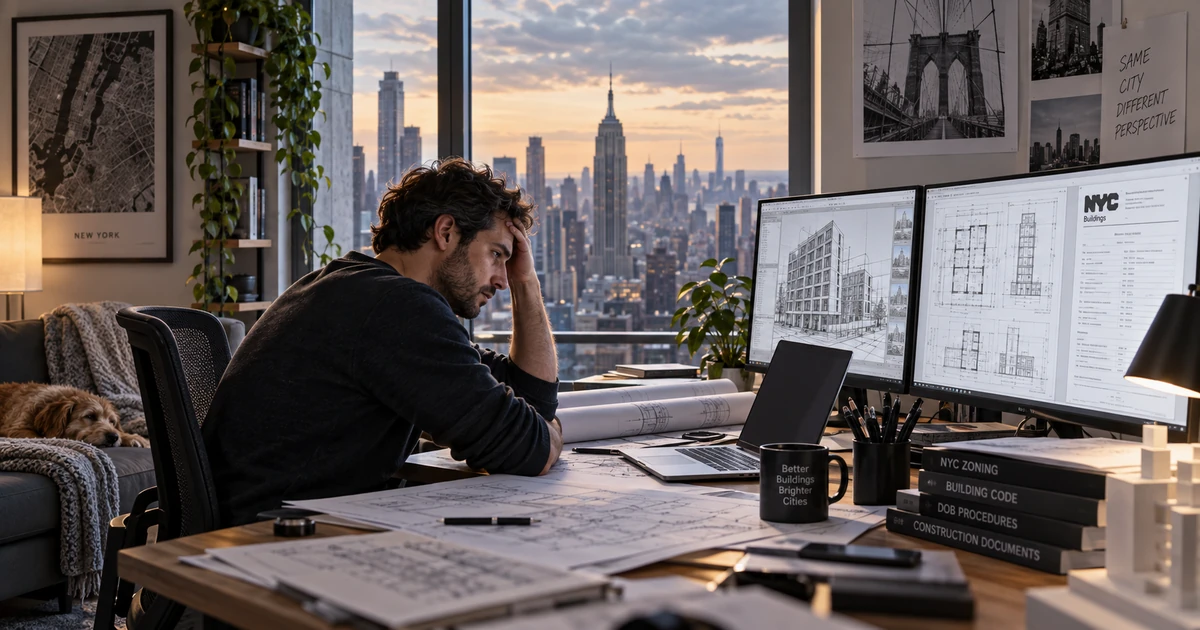
When working from home turns into spending eight, ten, or even twelve hours a day behind the same desk, in the same room, looking at the same screens, the convenience of remote work can gradually become a form of isolation.
Some people describe the resulting feeling as cabin fever.
Cabin fever is not a formal medical diagnosis. It is an informal term often used to describe feelings such as restlessness, boredom, irritability, lack of motivation, difficulty concentrating, and the sense of being mentally trapped after spending too much time in the same environment.
For architects, this subject deserves particular attention because architecture has quietly become an increasingly screen-based profession.
And in a city such as New York, there is another interesting part of the discussion: the relationship between architects, field professionals, contractors, and DOB expeditors may provide something that remote work cannot fully replace—regular contact with the physical city and the people who actually make buildings happen.
Architecture Was Never Supposed to Be Only a Desk Job
Architecture is about physical space.
Architects design rooms, buildings, streets, entrances, façades, stairs, apartments, stores, offices, and public spaces that people eventually experience with their bodies.
Yet much of the modern architectural process takes place inside a computer.
An architect may spend an entire day moving between:
AutoCAD
Revit
SketchUp
Rhino
Adobe software
Building-code documents
Zoning regulations
Email
Microsoft Teams
Zoom
Project-management platforms
Construction specifications
DOB NOW
Technology has made architectural work significantly more efficient.
It has also made it possible to complete enormous portions of the design process without physically interacting with the building being designed.
Even emerging technologies such as artificial intelligence in architecture, DOB expediting, and building-code research are further reducing the amount of repetitive administrative work professionals need to perform manually.
That technological progress is useful.
The challenge begins when digital efficiency removes too much of the human and physical experience from the profession.
What Does Cabin Fever Mean in the Context of Remote Work?
Imagine waking up, making coffee, walking ten feet to a desk, opening your computer, and working there until evening.
You may technically communicate with twenty people during the day.
There may be emails from contractors, Teams messages from coworkers, comments from engineers, and three Zoom meetings.
Yet physically, you may have spent the entire day alone.
The next day may look almost identical.
And then the next.
That is where remote work can begin to feel psychologically different from working in a traditional office or moving between job sites.
The expression cabin fever is often used to describe the uncomfortable feelings associated with prolonged confinement, monotony, isolation, or lack of stimulation.
A person experiencing this kind of restlessness may notice things such as:
Difficulty concentrating
Irritability
Reduced motivation
Boredom
Feeling mentally stagnant
Irregular sleep habits
Spending excessive time online
Reduced enthusiasm for work
Feeling disconnected from colleagues
Difficulty separating work from personal life
A strong desire simply to leave the house
These experiences do not automatically indicate a mental-health disorder.
But they can be signs that a person’s work environment and daily routine may need adjustment.
The Strange Problem With Working From Home: You Never Really Leave Work
One of the traditional benefits of commuting is that it creates a physical boundary between professional and personal life.
You leave your apartment.
You travel to an office.
You work.
Then you leave the office and return home.
That transition tells the brain that the workday has ended.
Remote work can eliminate that boundary.
The bedroom becomes the office.
The dining table becomes the conference room.
The living room becomes the break room.
And the computer may remain only a few feet away all evening.
For architects, this can be particularly difficult because architectural work rarely feels completely finished.
There is always another detail to review.
Another drawing could be improved.
One more email could be answered.
One more DOB objection could be researched.
One more zoning question could be investigated.
When the office and home are the same place, it becomes very easy for an eight-hour workday to quietly become a ten- or twelve-hour workday.
Why Architects May Be Especially Vulnerable to Long Hours Behind a Desk
Architecture combines creative work with technical concentration.
A professional may move between design decisions, construction details, zoning calculations, code research, consultant coordination, client communication, and agency requirements throughout the same day.
For example, preparing architectural plans and DOB filing documentation can involve prolonged periods of highly focused computer work.
That concentration can be productive.
But concentration without enough movement or environmental change can also become exhausting.
There are several reasons architectural work can become particularly desk-heavy.
1. Architectural Software Requires Long Periods of Concentration
Building-information modeling and CAD software reward uninterrupted concentration.
Once an architect becomes deeply involved in a drawing set, several hours can disappear quickly.
The problem is that the human body does not necessarily recognize whether someone is doing productive architectural work or simply sitting.
Either way, the individual may remain physically inactive for a long period.
The solution is not to abandon technology.
It is to remember that productivity and movement do not have to be opposites.
2. Architecture Creates an Endless-To-Do-List Mentality
Architecture rarely provides a clean stopping point.
A project might have 40 sheets, hundreds of details, multiple consultants, owner comments, contractor RFIs, zoning questions, agency objections, and inspection requirements.
When working remotely, that unfinished project is always psychologically nearby.
Architects can therefore develop the habit of thinking:
“I’ll just fix one more thing.”
One detail becomes another detail.
Suddenly it is 9:00 p.m.
3. Creative Work Needs Environmental Stimulation
Architecture depends partly on observation.
Cities themselves are architectural education.
Walking through Manhattan, Brooklyn, Queens, the Bronx, or Staten Island exposes architects to materials, storefronts, construction techniques, building proportions, façades, accessibility conditions, zoning patterns, and human behavior.
A person working exclusively from a home office loses some of those spontaneous observations.
Architecture begins to exist primarily on the screen rather than in the city.
That can gradually make creative work feel more abstract and repetitive.
Remote Work Does Not Affect Everyone the Same Way
It is important not to turn remote work into the villain.
Some architects are significantly happier and more productive working remotely.
They eliminate long commutes.
They may have fewer interruptions.
They can spend more time with family.
They may have greater control over their work environment.
Others prefer the social energy of an office.
And many professionals may find that hybrid work gives them the best balance.
Research on remote work generally suggests that its effect depends heavily on circumstances such as autonomy, workload, social support, personality, home environment, and the ability to separate work from personal life.
The important question therefore is not:
“Is remote work good or bad?”
A better question is:
“Is the way I am working remotely still healthy and productive for me?”
Why Architecture Needs Contact With the Real World
There is an old lesson in architecture that remains important regardless of how sophisticated software becomes:
The drawing is not the building.
A wall represented by two perfectly straight lines in AutoCAD may be completely uneven in a 100-year-old Manhattan building.
A ceiling that appears empty on a drawing may contain ducts, pipes, beams, conduit, sprinkler lines, and abandoned mechanical equipment.
A stair that looks acceptable on an old plan may be different in the field.
A Certificate of Occupancy may describe one condition while the existing building shows another.
This is one reason HN Republic emphasizes connecting architectural plans with actual project conditions and the DOB filing process.
Field visits force architects to reconnect the digital representation of architecture with physical reality.
They also force us to get out of the chair.
The Architect and the NYC Expeditor: Two Different Ways of Experiencing a Project
The relationship between architects and expeditors in New York City is particularly interesting when discussing remote work.
Traditionally, architects spend a significant amount of time developing drawings, coordinating consultants, researching codes, and resolving design issues.
Expeditors operate closer to the administrative and regulatory movement of the project.
A knowledgeable NYC DOB expeditor may coordinate among:
Architects
Engineers
Contractors
Owners
Property managers
Special inspectors
Licensed trades
DOB personnel
Other city agencies
Modern DOB expediting has also become much more digital because many applications now move through DOB NOW.
So the stereotype of an expeditor spending the entire day physically walking documents between government offices is outdated.
Nevertheless, the role remains highly people-oriented and coordination-oriented.
The expeditor constantly moves between different perspectives.
The architect may be thinking:
“Does the drawing satisfy the design and code requirements?”
The contractor may be thinking:
“How do I build this?”
The owner may be thinking:
“When can construction begin?”
The expeditor may be thinking:
“What is preventing this application from moving to the next step?”
That creates a very different rhythm from spending eight uninterrupted hours producing drawings.
Expediting Can Reconnect Architecture With People
One underestimated benefit of interdisciplinary work is that it breaks professional isolation.
When architects interact regularly with expeditors, contractors, engineers, owners, plan examiners, inspectors, and field personnel, architecture becomes a conversation again.
Instead of staring exclusively at drawings, the architect receives feedback from the real project.
The contractor explains a construction conflict.
The expeditor identifies a filing problem.
The owner changes an operational requirement.
The inspector raises a field condition.
The engineer proposes a technical solution.
The architect then returns to the drawings with more context.
This circulation between desk work and human interaction can make architectural practice more dynamic.
It can also remind architects why those drawings exist in the first place.
NYC DOB Work Can Become Its Own Form of Screen Fatigue
There is another side to this story.
Expeditors are not immune to desk fatigue.
NYC filing professionals increasingly spend large portions of their day using online systems.
Understanding the difference between DOB NOW and the older DOB BIS system alone can require substantial computer research, particularly when a property has decades of filing history.
An expeditor may spend hours:
Uploading documents
Reviewing DOB records
Tracking applications
Responding to objections
Coordinating signatures
Reviewing permits
Checking inspection status
Researching old applications
Communicating with project teams
So architects and expeditors now share many of the same digital-work challenges.
That makes intentional movement and face-to-face interaction valuable for both professions.
Architecture Is Also a Social Profession
Architecture schools often emphasize design and technical ability.
But professional architecture is surprisingly social.
A successful project may require conversations with dozens of people.
That includes:
Clients
Engineers
Contractors
Expeditors
Consultants
Inspectors
Building managers
Superintendents
Neighbors
Agency reviewers
Real-estate professionals
At HN Republic, our approach to architecture, zoning, construction, and DOB coordination is based on connecting these different participants rather than treating each part of the project as an isolated task.
That same principle can apply to the professional lives of architects.
Isolation may make individual tasks more efficient.
But collaboration often makes the profession itself more meaningful.
Simple Ways Architects Can Reduce the Feeling of Cabin Fever
Solving the problem does not necessarily require returning to an office five days per week.
Small changes can significantly alter the rhythm of the workday.
Leave the House Before Starting Work
Even a short morning walk can create a psychological transition between home and work.
Instead of walking from the bed directly to the computer, create a miniature commute.
Walk outside.
Get coffee.
Walk around the neighborhood.
Then return and begin working.
Take Calls While Walking
Not every conversation requires a screen.
If a meeting does not involve reviewing drawings, consider taking the call while walking.
This creates movement without necessarily reducing productivity.
Schedule Site Visits
Do not treat site visits only as obligations.
They can provide valuable architectural education.
Observe how materials are installed.
Talk with contractors.
Look at how details actually come together.
Compare existing conditions with drawings.
A site visit can sometimes teach more than another hour behind the computer.
Work From Somewhere Else Occasionally
A home office does not need to be the only workplace.
Depending on the task, consider working occasionally from:
The office
A coworking environment
A library
A quiet café
A shared studio
Even a different visual environment can make repetitive computer work feel less monotonous.
Create a Hard Stop
Remote workers often need to intentionally recreate the boundary that commuting once provided automatically.
Choose a time when work ends.
Close the laptop.
Leave the room.
Go outside.
Exercise.
Meet someone.
The architectural project will still exist tomorrow.
Maintain Professional Relationships in Person
Architecture is partly built through relationships.
Meet contractors.
Visit clients.
Attend industry events.
Speak with engineers.
Meet property managers.
Interact with other architects.
Talk with expeditors.
Those conversations are not interruptions to architecture.
They are part of architecture.
The Future May Be Hybrid—Not Simply Remote or Office-Based
The most productive architectural workplace of the future may not require choosing between complete remote work and complete office work.
A better model for many professionals could be intentional hybrid work.
Use remote work for tasks requiring deep concentration:
Drawing production
Writing
Code research
Zoning analysis
Specifications
Focused design development
Use physical interaction for tasks that benefit from people and place:
Site surveys
Construction meetings
Client presentations
Coordination meetings
Inspections
Industry networking
Agency-related coordination
Field problem solving
This approach recognizes something architecture has always understood:
Different spaces support different activities.
It would be strange for an architect to design an office, restaurant, apartment, and classroom as if every activity required exactly the same environment.
Our own professional lives should probably follow the same principle.
NYC Architecture Makes Human Interaction Particularly Important
New York City buildings are complicated.
A project can involve zoning, building-code requirements, old permits, legacy BIS records, DOB NOW applications, violations, Certificates of Occupancy, Landmarks requirements, multiple contractors, consultants, and decades of previous alterations.
Understanding the city’s zoning and building-code requirements often requires more than reading regulations in isolation.
It requires understanding the property.
The building.
The client’s objective.
Existing records.
Field conditions.
And how all of those pieces interact.
That process benefits enormously from communication between architects, expeditors, engineers, contractors, owners, and other members of the project team.
Remote technology can make those conversations easier.
It should not eliminate them.
Final Thoughts: Architects Design Space, but Space Also Affects Architects
Architects spend their careers thinking about how spaces affect people.
We consider daylight.
Circulation.
Room proportions.
Views.
Privacy.
Movement.
Comfort.
Interaction.
Yet it is easy to forget that the spaces where architects themselves work affect them too.
Working remotely can be efficient, flexible, and productive.
But when remote work becomes prolonged isolation—hours behind a screen, minimal movement, little environmental variety, and weak separation between work and home—the benefits can begin to diminish.
That is when people may start describing the experience as cabin fever.
The answer is not necessarily to abandon remote work.
It may simply be to restore some of what architecture has always depended on:
movement, observation, physical places, collaboration, and human interaction.
For architects practicing in New York City, working closely with contractors, engineers, owners, inspectors, and DOB expeditors can provide more than project coordination. It keeps architectural work connected to the physical buildings and people that the drawings are ultimately meant to serve.
Technology should make architecture more efficient.
It should not make architects disconnected from architecture itself.
Educational and Health Disclaimer
This article is provided for general educational and informational purposes only. “Cabin fever” is an informal term and is not presented here as a medical or psychiatric diagnosis. Remote work affects individuals differently, and feelings such as persistent anxiety, depression, severe stress, sleep problems, or other mental-health concerns should be discussed with an appropriate qualified healthcare professional.
HN Republic provides architectural, zoning, construction-coordination, and NYC Department of Buildings expediting services and does not provide medical or mental-health services.