What Is a Zoning Resolution Determination (ZRD1) in NYC?
New York City zoning can become complicated very quickly. A project that looks straightforward on paper may raise questions about permitted use, floor area, building height, setbacks, yards, parking, nonconforming conditions, or the way a particular section of the NYC Zoning Resolution should be applied.
In many cases, those questions can be resolved through normal zoning analysis and DOB plan examination. But sometimes the issue is not clear enough to move forward without a formal decision from the New York City Department of Buildings.
That is where a Zoning Resolution Determination, commonly known as a ZRD1, becomes important.
A ZRD1 determination allows an applicant to request an official DOB decision regarding the application of the New York City Zoning Resolution to a particular property, design, or zoning issue.
This guide explains what a ZRD1 is, when it may be appropriate, how the determination process works, and what property owners, developers, architects, and project teams should understand before submitting one.
What Does ZRD1 Mean?
ZRD1 stands for Zoning Resolution Determination.
It is the DOB process used to request a formal determination concerning a provision of the NYC Zoning Resolution.
The Zoning Resolution controls many of the fundamental development rules affecting property in New York City, including:
- Permitted land uses
- Residential, commercial, and manufacturing zoning districts
- Floor area and Floor Area Ratio
- Building height and setback
- Required yards
- Lot coverage
- Parking requirements
- Street-wall requirements
- Special Purpose District regulations
- Nonconforming uses
- Noncomplying buildings
- Various zoning bonuses, exemptions, and special conditions
If you are unfamiliar with the overall zoning system, our guide to the New York City Zoning Resolution provides a useful introduction to how NYC zoning districts and regulations work.
A ZRD1 becomes relevant when the issue goes beyond simply identifying the applicable zoning rule and instead requires a formal DOB determination about how that rule applies to a particular situation.
When Is a ZRD1 Determination Used?
Under the current DOB process, determination requests are generally used in two important situations.
The first is a pre-determination involving a potential zoning issue before the associated DOB application has been filed.
The second involves an existing plan-examination objection. Before an applicant can escalate an objection through a ZRD1 determination, DOB requires the objection to go through the second plan-examination review process and be upheld. The applicant may then request a formal determination regarding the affirmed zoning objection.
This distinction is important.
A ZRD1 should not automatically be filed every time a plan examiner issues a zoning objection. Many objections can be resolved by revising the drawings, supplying additional documentation, correcting the zoning calculations, or explaining the applicable zoning section during plan examination.
Formal determinations are generally reserved for issues that require a higher-level interpretation or decision.
Predetermination Before Filing a DOB Application
One useful application of the ZRD1 process is obtaining a predetermination before a project is formally filed.
Imagine that a developer is evaluating a property and the entire project depends on a particular interpretation of the zoning regulations.
Instead of completing an extensive architectural design and discovering the problem during plan examination, the project team may seek clarification earlier.
A predetermination can be especially valuable when an unresolved zoning question could materially affect:
- Development potential
- Building configuration
- Permitted floor area
- Proposed use
- Parking layout
- Building height
- Yard configuration
- An enlargement
- Conversion of an existing building
Early zoning review does not mean every project needs a ZRD1. Most projects can be evaluated through a detailed NYC zoning and building-code analysis before determining whether a formal DOB decision is actually necessary.
ZRD1 and DOB Plan Examination Objections
Another common situation occurs after an application has already been filed.
During DOB plan examination, the examiner may issue a zoning objection. The applicant can respond with revised drawings, calculations, supporting records, and an explanation of how the proposed work complies with the Zoning Resolution.
If disagreement remains, the applicant may request a second review of the objection.
Under DOB’s current determination procedure, that second review must affirm the objection before an objection-level ZRD1 determination can be submitted to escalate the matter.
This creates a logical sequence:
Plan Examination → Zoning Objection → Applicant Response → Second Review → Affirmed Objection → ZRD1 Determination
Understanding this sequence can prevent an applicant from pursuing a determination prematurely.
For projects already moving through DOB review, professional DOB expediting and permit coordination can help organize objections, supporting documents, filing steps, and agency follow-up.
What Types of Zoning Questions Can Lead to a ZRD1?
Every project is different, but zoning determination questions can involve subjects such as:
Floor Area and FAR
One of the most important concepts in NYC development is Floor Area Ratio, or FAR.
Questions may arise about whether a particular space counts as zoning floor area, how floor area should be calculated, or which floor-area regulation applies to a property.
Because relatively small changes in zoning floor area can significantly affect a development, the issue may become critical to the project’s feasibility.
You can learn more in our detailed guide to Floor Area Ratio in NYC zoning.
Permitted Use
A proposed use may raise questions regarding whether it is allowed within the applicable zoning district or whether particular restrictions apply.
This can become especially important for commercial spaces, community facilities, manufacturing areas, mixed-use buildings, and properties located within Special Purpose Districts.
Height and Setback
Zoning regulations may establish maximum building heights, required setbacks, street-wall conditions, sky-exposure-plane rules, or other bulk controls.
Irregular lots and existing buildings can make these calculations considerably more complicated.
Yards and Lot Conditions
Rear yards, side yards, rear-yard equivalents, through lots, corner lots, and irregular zoning lots can produce questions that are not always resolved simply by looking at a zoning map.
Existing Nonconforming or Noncomplying Conditions
Older NYC buildings often contain conditions that predate today’s zoning regulations.
A building may contain a legal nonconforming use or may be legally noncomplying with current bulk regulations. Determining what can remain, what may be altered, and how enlargement or reconstruction rules apply can require detailed historical research.
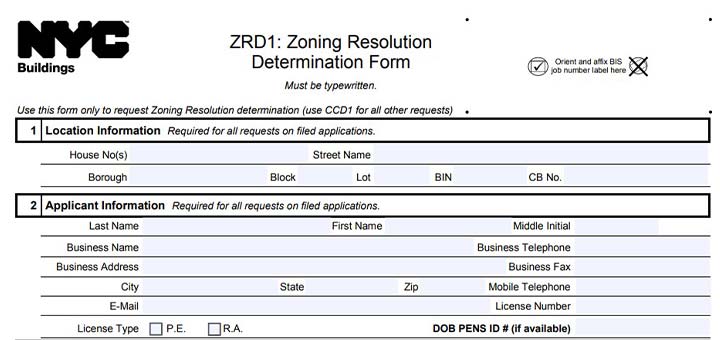
What Should a Strong ZRD1 Request Include?
A determination request should focus on a specific zoning question, not simply ask DOB to review the entire project.
The issue should be clearly stated and supported by the applicable provisions of the Zoning Resolution.
Depending on the question, supporting documentation may include:
- Relevant Zoning Resolution sections
- Zoning maps
- Tax-lot information
- Property survey
- Zoning calculations
- Architectural drawings
- Site plans
- Floor plans
- Sections and elevations
- Certificates of Occupancy
- Historical DOB records
- Previous approvals or determinations
- Photographs
- The latest DOB objection information
- A written explanation of the requested determination
The goal is to make the question understandable without forcing the reviewer to reconstruct the entire history of the project.
For projects requiring drawings in addition to zoning analysis, HN Republic’s architectural plans and DOB filing services can help coordinate existing conditions, filing drawings, zoning review, and the DOB application process.
How Does DOB Review a ZRD1 Request?
DOB determination requests are reviewed by the appropriate borough office.
The result may be:
Approved – DOB accepts the requested determination.
Approved with conditions – DOB accepts the request subject to specific limitations or requirements.
Denied – DOB does not accept the requested zoning position.
DOB currently states a service level of approximately 10 business days for determination review, although actual project timing can depend on the request, documentation, and surrounding circumstances.
A determination should therefore be viewed as a formal technical process rather than a guaranteed method of obtaining the applicant’s preferred interpretation.
How Much Does a ZRD1 Cost?
DOB currently lists a $1,000 fee for a ZRD1 or CCD1 determination request, including qualifying pre-determinations and appeals of affirmed objections after second plan-examination review.
If the borough determination is denied and the applicant appeals the decision through DOB’s Technical Affairs Unit, the current listed appeal fee is $2,500.
Fee-exempt projects may also be exempt from determination fees.
Because fees and DOB procedures can be amended, the current DOB requirements should always be confirmed before filing.
What Happens If a ZRD1 Is Denied?
A denial does not necessarily end the process.
According to DOB’s determination procedure, an applicant may appeal a denied borough determination to the Department’s Technical Affairs Unit.
If that appeal is also denied, further zoning relief or review may potentially involve the New York City Board of Standards and Appeals, depending on the issue and applicable procedure.
This is why the original determination request should be carefully developed. A weak narrative, incomplete zoning analysis, missing documentation, or poorly defined question can make an already complicated issue more difficult.
ZRD1 vs. CCD1: What Is the Difference?
ZRD1 and CCD1 requests are related processes, but they address different regulations.
A ZRD1 deals specifically with the NYC Zoning Resolution.
A CCD1, or Construction Code Determination, addresses qualifying questions involving construction-code requirements and certain other regulations administered through the DOB determination process.
For example, a disagreement involving permitted floor area or zoning setback would generally be a zoning matter.
A technical question involving the application of a construction-code provision may instead require a CCD1.
For more information, read our guide to the CCD1 Construction Code Determination process.
Is a ZRD1 Necessary for Every Difficult Zoning Question?
No.
This is one of the most important points for property owners and project teams to understand.
A complicated zoning question does not automatically require a determination.
Sometimes the issue can be resolved through:
- Better zoning analysis
- Corrected drawings
- Additional calculations
- Historical DOB research
- Previous approved plans
- Certificate of Occupancy research
- Discussion during plan examination
- Second review of a DOB objection
A formal determination becomes appropriate when the applicable DOB process and the nature of the issue justify escalation.
The objective should not be to file more forms. The objective should be to identify the simplest defensible path toward project approval.
Why Early Zoning Analysis Matters
Many expensive DOB problems actually begin long before the application reaches the plan examiner.
An owner may sign a commercial lease before confirming the proposed use. A developer may design an enlargement without verifying available floor area. An architect may discover an unusual zoning-lot condition after significant design work has already been completed.
A careful zoning review at the beginning of a project can identify many of these issues before they become expensive redesigns or DOB objections.
When uncertainty remains after that review, the project team can determine whether a formal ZRD1 predetermination is the appropriate next step.
Final Thoughts
The ZRD1 Zoning Resolution Determination process is an important tool for resolving significant zoning questions within the NYC Department of Buildings approval system.
It can be used to address qualifying zoning issues before an application is filed or to seek a higher-level decision after a zoning objection has gone through the required plan-examination review process.
However, a ZRD1 should not replace good zoning analysis.
A successful strategy begins by understanding the property, reviewing the applicable zoning district and regulations, identifying the precise issue, researching the building history, and determining whether the question can be resolved through normal DOB review or requires a formal determination.
HN Republic provides NYC zoning consulting, architectural coordination, DOB filing, expediting, and determination support for property owners, developers, contractors, architects, engineers, and real-estate professionals throughout New York City.
If your project has a difficult zoning issue or unresolved DOB objection, you can contact HN Republic to discuss the property and determine the appropriate next step.
Educational Disclaimer: This article is provided for general educational and informational purposes only. NYC zoning regulations, DOB procedures, fees, forms, and filing requirements are subject to amendments and project-specific interpretation. The applicable requirements should be verified for each individual property and project.