What Is a Construction Code Determination (CCD1) in NYC?
New York City construction projects do not always fit neatly into a single Building Code provision. Existing buildings may contain unusual conditions, different code provisions may appear to overlap, or a proposed design may require an alternative method of compliance because strict application of a requirement creates a practical difficulty.
When an important Construction Code question cannot be resolved through the normal NYC Department of Buildings review process, a Construction Code Determination, commonly called a CCD1, may provide a formal path for review.
A CCD1 allows an applicant to request an official determination from the New York City Department of Buildings regarding certain Construction Code issues. Depending on the circumstances, it may be used before a DOB application is filed, after a plan-examination objection has gone through the required review process, or for qualifying requests involving a variation from a code requirement.
Understanding when a CCD1 is appropriate is important because it is not simply another form to file whenever a project receives an objection. In many cases, a code issue can be resolved through drawings, calculations, supporting documentation, or a second review of the objection.
This guide explains what the CCD1 process is, when it may be used, how it differs from a ZRD1, and what architects, engineers, property owners, contractors, and developers should understand before requesting a Construction Code Determination.
What Is a CCD1 Construction Code Determination?
CCD1 stands for Construction Code Determination.
The NYC Department of Buildings uses the determination process to review qualifying questions involving the Construction Codes, including the 2014 Construction Code, the 1968 Building Code, and certain provisions of the New York State Multiple Dwelling Law.
A CCD1 may involve a request for interpretation or clarification, a qualifying request for variation from a Building Code or DOB rule, or certain other technical matters permitted under the DOB determination process.
In practical terms, a CCD1 becomes important when a project has a specific technical code question that cannot be satisfactorily resolved through ordinary plan examination.
For example, an existing building may have a physical condition that makes literal compliance extremely difficult. In another project, the design professional and DOB examiner may disagree about how a particular Construction Code provision applies to the proposed work.
Before pursuing a formal determination, the underlying project should first receive a careful code review. HN Republic’s NYC Zoning and Building-Code Consulting service can help identify the applicable regulations and determine whether the issue is likely to require normal plan-exam coordination or a higher-level determination.
When Can a CCD1 Be Requested?
The NYC DOB determination process generally provides two major paths for a CCD1.
The first is a predetermination for a potential issue associated with an application that has not yet been filed.
The second involves escalation of a DOB plan-examination objection after the applicant has completed the required second review process and the objection remains upheld.
These two situations are very different, but both can be valuable when the unresolved code issue could significantly affect the project.
CCD1 Predetermination Before Filing
Sometimes a major Construction Code question becomes apparent during design, before a formal DOB application has been submitted.
If the entire design depends on DOB accepting a particular interpretation or compliance approach, obtaining clarification before completing the filing package may help reduce the risk of expensive redesign later.
Imagine, for example, that an existing building has an unusual configuration affecting egress, construction classification, or another major code requirement. If the project team develops the entire design based on one interpretation and DOB later disagrees, substantial portions of the project may need to be redesigned.
A predetermination allows a qualifying applicant to present the specific question earlier in the process.
Under DOB’s current guidance, the applicant for a predetermination must fall within an authorized professional category, such as a Registered Architect, Professional Engineer, Registered Landscape Architect, certain licensed elevator professionals, or an attorney where there is no Applicant of Record.
For projects that are still in the design stage, HN Republic’s Architectural Plans and DOB Filing service explains how code review, architectural documentation, filing coordination, and plan-exam responses can be integrated before construction begins.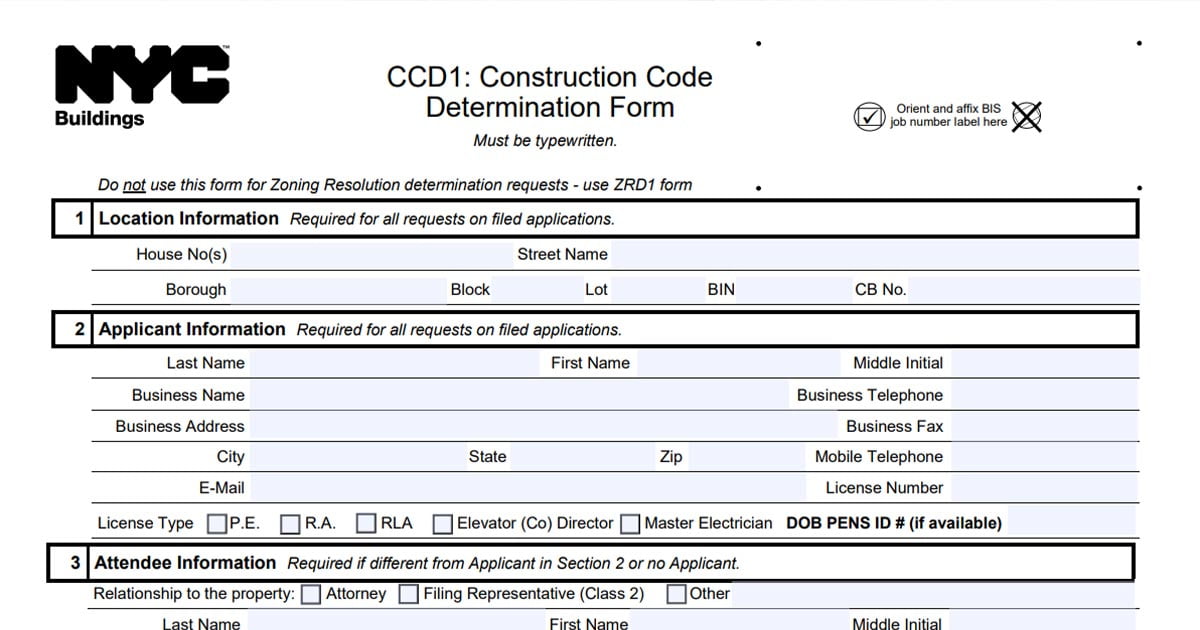
Using a CCD1 After a DOB Objection
A common misunderstanding is that an applicant can immediately file a CCD1 every time a DOB plan examiner issues an objection.
That is not the current process.
When a plan examiner issues an objection and the applicant disagrees with DOB’s interpretation, the applicant must first request a second review of the plan-examination objection. This second review is part of the application process and does not require the determination fee.
If the objection remains upheld after that review, the applicant may either revise the project to comply with DOB’s interpretation or proceed with a CCD1 determination request to escalate the issue.
The general sequence is therefore:
Plan Examination → DOB Objection → Applicant Response → Second Review → Objection Upheld → CCD1 Determination
This sequence matters because filing a determination prematurely can waste time and create unnecessary expense.
The goal should always be to resolve the issue at the simplest appropriate level.
For applications already in DOB review, HN Republic provides DOB expediting and permit coordination services to assist with filing strategy, objection tracking, agency coordination, permits, and project follow-up.
What Types of Issues May Be Addressed Through a CCD1?
CCD1 requests generally relate to Construction Code matters rather than zoning.
A technical question might involve the application of a Building Code provision to an existing condition, the interpretation of a requirement, or a request for an authorized variation where strict compliance creates a project-specific practical difficulty.
The current CCD1 form also identifies certain requests involving Article 7B buildings under Multiple Dwelling Law §277.16. Other Multiple Dwelling Law variations may require a different process, including review by the Board of Standards and Appeals.
Electrical Special Permission requests also use the CCD1 process, although DOB applies separate fees and procedures to qualifying electrical variations.
The important point is that a CCD1 should address a clearly defined technical question. It should not simply ask DOB to review the entire project and determine whether the building complies with every applicable code requirement.
Requesting a Code Variation
One particularly important use of the determination process involves requests for a variation from certain Building Code requirements or DOB rules.
A variation is different from simply arguing that a code section has been interpreted incorrectly.
For a qualifying variation request, the applicant generally needs to explain the practical difficulty specific to the project and demonstrate an alternative approach that provides an appropriate level of safety.
The CCD1 form specifically asks applicants requesting a variation under Administrative Code §28-103.3 to describe the practical difficulty and provide an analysis of an equally safe alternative.
This means that simply stating that compliance is expensive or inconvenient is generally not enough to create a strong technical request.
The submission should explain the actual building condition, the relevant requirement, why the difficulty exists, and how the proposed alternative addresses the underlying safety objective.
What Should a Strong CCD1 Submission Contain?
A successful CCD1 strategy begins with a narrowly defined question.
The narrative should explain the existing or proposed condition, identify the applicable code provisions, describe the issue requiring determination, and clearly state what the applicant is asking DOB to decide.
Supporting documentation depends on the project but may include architectural drawings, sections, diagrams, photographs, surveys, code analyses, calculations, existing Certificates of Occupancy, prior DOB approvals, historical records, or the applicable objection sheet.
If the determination is based on a plan-exam objection, the relevant objection and project context should be clearly documented.
A good submission should make the technical issue understandable to a reviewer who has not been involved in every previous discussion surrounding the project.
This is one reason early code research matters. A vague determination request can create additional questions instead of resolving the original problem.
CCD1 vs. ZRD1: What Is the Difference?
CCD1 and ZRD1 requests serve related purposes, but they address different areas of NYC regulation.
A CCD1 Construction Code Determination generally addresses qualifying Construction Code, Building Code, certain Multiple Dwelling Law, and related technical issues.
A ZRD1 Zoning Resolution Determination addresses questions involving the NYC Zoning Resolution.
For example, a dispute about construction, egress, fire protection, or another qualifying building-code provision may involve a CCD1.
A question involving permitted floor area, zoning use, yards, building height, setbacks, or another Zoning Resolution provision would generally be handled through a ZRD1.
For zoning-related issues, see HN Republic’s guide to the ZRD1 Zoning Resolution Determination process.
Choosing the correct path is important because a building-code determination cannot substitute for a zoning determination, and the reverse is also true.
How Are CCD1 Requests Filed Today?
The DOB process has changed significantly from the older paper and email-based system.
For most new determination requests involving both DOB NOW and BIS applications, applicants use DOB NOW and select the appropriate Determination option. Fees are also submitted through DOB NOW.
There are exceptions for certain requests that began under the previous paper process, which may need to continue through that original procedure. Electrical Special Permission matters also retain specific CCD1 requirements.
Because the filing system and DOB procedures can change, applicants should verify the current instructions before submitting a request rather than relying on an older CCD1 example found online.
How Much Does a CCD1 Cost?
The NYC Department of Buildings currently lists a $1,000 fee for a CCD1 determination request. This applies to qualifying predeterminations, variations, and appeals of an affirmed objection after the required second plan-examination review.
If the borough determination is denied and the applicant appeals the decision to DOB’s Technical Affairs Unit, the current listed appeal fee is $2,500.
Fee-exempt projects may also qualify for exemption from determination fees. DOB lists a different $350 fee structure for qualifying CCD1 Electrical Code variations and related appeals.
DOB currently states a 10-business-day service level for determination review, although project complexity, supporting information, and procedural issues can influence the overall time required to resolve the matter.
What Happens After DOB Reviews the Determination?
The appropriate borough office reviews the request and may approve it, approve it with conditions, or deny it.
If the borough office denies the CCD1 determination, the applicant may appeal the decision to DOB’s Technical Affairs Unit.
If DOB subsequently denies that appeal, further review may potentially proceed to the New York City Board of Standards and Appeals, depending on the issue and applicable procedure.
This is another reason to prepare the original request carefully. The determination process should be treated as a technical regulatory procedure rather than a routine administrative form.
Do You Need a CCD1 for Every Difficult DOB Objection?
No.
Most DOB objections should not automatically become CCD1 requests.
Many issues can be resolved by correcting the drawings, providing additional documentation, revising calculations, explaining the applicable code section, or using the second-review process.
A formal determination is most useful when the project has a genuine issue of code interpretation, an authorized variation request, or another matter that cannot reasonably be resolved through normal DOB review.
The best strategy is usually to understand the code issue first and choose the filing procedure second.
Final Thoughts
The NYC DOB CCD1 Construction Code Determination process can be an important tool for projects involving difficult Building Code questions, unusual existing conditions, qualifying code variations, or unresolved DOB objections.
However, CCD1 should not be viewed as a shortcut around normal plan examination.
A strong project strategy begins with a careful review of the existing building, proposed work, applicable code, occupancy, drawings, prior approvals, and DOB records. The project team can then determine whether the issue can be resolved through normal plan review, a second review of an objection, or a formal Construction Code Determination.
HN Republic assists property owners, developers, contractors, architects, engineers, and real-estate professionals with NYC building-code research, architectural filing coordination, DOB expediting, objection resolution, and determination-related project coordination.
If you have a difficult DOB objection or Construction Code issue, you can contact HN Republic with the property address, DOB application number, objection sheet, and a brief description of the issue.
Educational Disclaimer: This article is provided for general educational and informational purposes only. NYC Construction Codes, agency interpretations, fees, DOB NOW procedures, Multiple Dwelling Law requirements, and determination procedures are subject to change. Project-specific requirements should be confirmed with the NYC Department of Buildings and the appropriate licensed professionals.