


Remote Work and Cabin Fever: The Hidden Challenge for Architects
Hamoun Niknejad2026-09-06T16:43:05+00:00For many professionals, working from home means flexibility, fewer commutes, more control over the day, and the ability to focus without constant office interruptions. An architect can open a laptop in the morning, review drawings, answer emails, join a Zoom meeting, revise a Revit model, research the building code, and communicate with consultants without ever leaving home.From a productivity standpoint, that can sound ideal.But there is another side to it.When working from home turns into spending eight, ten, or even...

Construction General Contractors’ Duties
Hamoun Niknejad2026-09-06T15:17:59+00:00A successful construction project involves much more than hiring workers and ordering materials. From early planning through the final inspection, someone must coordinate the construction schedule, subcontractors, materials, budget, field conditions, safety requirements, inspections, and day-to-day decisions.That responsibility often falls primarily on the general contractor, commonly referred to as the GC.But what exactly does a general contractor do?The duties of a general contractor extend well beyond physical construction. A GC typically manages the day-to-day execution of the project, coordinates subcontractors,...
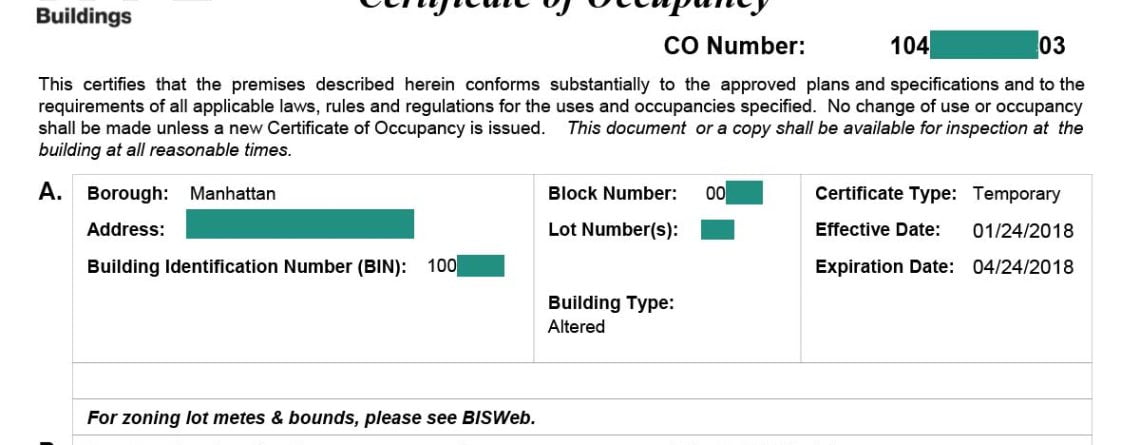
Certificate of Occupancy and TCO
Hamoun Niknejad2026-08-27T18:30:49+00:00A Certificate of Occupancy in NYC, commonly called a CO or C of O, is one of the most important records associated with a New York City building. It identifies the building's legal use and/or permitted type of occupancy and can become extremely important when a property is sold, refinanced, renovated, converted, leased, or reviewed by the New York City Department of Buildings.Many property owners do not pay much attention to the Certificate of Occupancy until a problem appears.A buyer's...

Minimum Room Size in NYC
Hamoun Niknejad2026-08-23T17:54:07+00:00New York City apartments use limited space efficiently, but fitting a bed or sofa does not make a room a legal bedroom or habitable room. The room must satisfy the rules for floor area, width, ceiling height, light, ventilation, and adjoining spaces.For many projects governed by the 2022 NYC Building Code, the general minimum room size in NYC is 80 square feet, with no plan dimension smaller than 8 feet. At least one habitable room in a dwelling unit must...