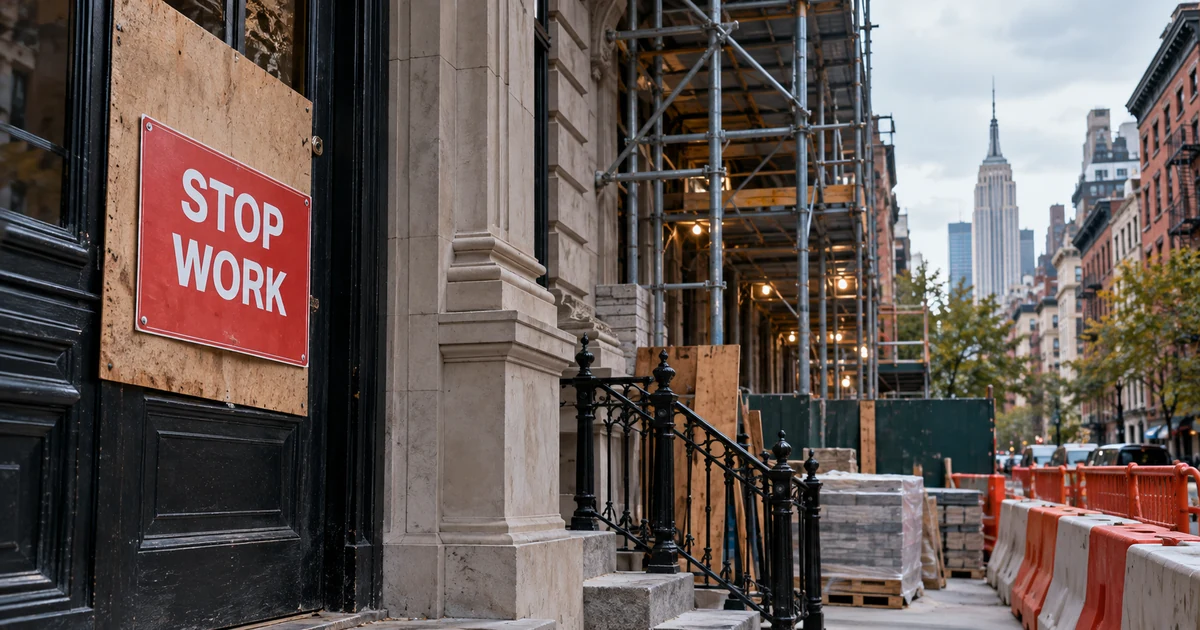
Stop Work Order Removal
A Stop Work Order (SWO) is an enforceable direction from DOB, not simply a warning about paperwork. Construction can resume only when the work is legally permitted, and DOB has rescinded the applicable order. Here is a practical way to handle the problem without losing sight of safety, documentation, and cost.
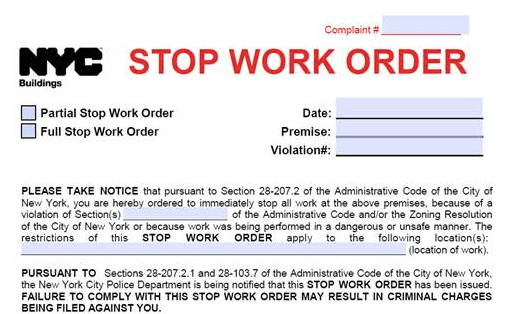
Full vs. partial Stop Work Orders
A full SWO generally prohibits all work at the affected site except the remedial activity permitted to make conditions safe. A partial SWO prohibits the work or activities specified in the order, which may be limited to a particular location or operation. Neither should be interpreted casually. Read the posted notice, identify the issuing DOB unit, and ask the construction team to document exactly which activities are restricted.
Common triggers include construction without a required permit, work that does not match approved plans, unsafe site conditions, and failures involving required safeguards. An open violation may accompany the SWO, but the violation, any OATH summons, and the SWO itself are separate administrative issues. Clearing one record does not automatically clear all the others. For context, read what a DOB violation means in NYC.
Step 1: Stop restricted work and preserve the record
Tell everyone on site what the order covers. Photograph the notice, work area, existing conditions, safety protection, and any exposed plumbing or structure before corrective activity changes the evidence. Record all relevant job and permit numbers. Keep the site secure; do not remove a posted notice or assume a subcontractor can continue because their trade was not mentioned.
If there is an urgent hazard, coordinate only the protective or remedial work authorized by the issuing unit. Use qualified professionals for life-safety repairs. If work was being performed without permits, ask the DOB expediting and permit coordination team to establish which applications are needed.
Step 2: Check both DOB systems and identify related violations
Research the property address and Building Identification Number in DOB NOW and BIS. Find active and historical jobs, permit status, approved scopes, complaints, and violations. Our DOB NOW versus BIS explanation helps clarify why information may be split across systems. Match every cited condition to an actual space and scope of work; Document record discrepancies.
Pay particular attention to drawings that no longer reflect the built conditions. For example, an interior renovation approved for nonstructural partitions may have involved unapproved beams or altered egress. In that situation, correcting the record often requires professional evaluation, not just a revised contractor statement. Architectural plans and DOB filing coordination may become part of the solution.
Step 3: Build a correction plan, not just a paperwork plan
The correction strategy depends on the reason for the order. It may require removing unauthorized work, restoring a safe condition, preparing signed and sealed drawings, obtaining the necessary permits, revising a previously approved application, or addressing an inspection objection. Discuss sequencing with the responsible registered architect or professional engineer and the licensed trades.
Create a short task tracker with five columns: cited condition, corrective action, responsible party, required proof, and status. If an OATH/ECB summons is also pending, put the hearing date and any cure or compliance deadlines on the same tracker. HN Republic’s violation resolution services coordinate the technical documentation and administrative follow-up; legal representation, when required, belongs with a qualified attorney.
Step 4: Obtain approvals, permits, and proof of correction
Submit the appropriate applications and supporting documents. An accepted filing is not a permit, and a permit is not a rescission of the SWO. That distinction is particularly important when the original violation was work without a permit. DOB explicitly states that work must remain stopped until both the permit is issued and the order is rescinded.
Keep dated photographs, inspection reports, contractor statements, approved plans, and correction certifications organized. Some violations may require a Certificate of Correction. For qualifying situations, the agency may demand additional documentation or action before rescission. Avoid promising a fixed timeline to the building owner until the issuing unit has identified its requirements.
Step 5: Request the reinspection through the issuing unit
After cited conditions are corrected, request reinspection through the DOB unit that issued the order. Confirm the correct contact or appointment procedure from the notice and current DOB guidance. The responsible team should attend with relevant permits, approved plans, safety documentation, and the person who can explain the corrections. If the inspector finds remaining conditions, obtain a specific list and address it methodically.
DOB may also require applicable civil penalties to be paid before it rescinds an SWO. Penalties for violating an order can be substantial. Under the DOB guidance available in October 2026, a first violation of an SWO carries a $6,000 civil penalty and a subsequent violation $12,000. These amounts refer to violating the order, not a universal fee for getting one lifted.
Step 6: Confirm rescission before restarting
Ask for confirmation that DOB has officially rescinded the full or partial SWO and check the public record when available. Inform the contractor in writing which work may restart and whether any other permit, safety, or inspection limits remain. If a partial order was rescinded, that does not excuse other prohibited work.
After construction resumes, watch the closeout path. A project can remain administratively open after construction ends. Our guide to closing an open DOB permit explains why the administrative finish matters.
How long does removal take?
There is no reliable universal number. A straightforward correction with complete documentation can proceed differently from an unsafe structural condition, an unpermitted occupancy change, or an older application requiring reinstatement. The owner’s best lever is to make corrections verifiable and prevent the team from submitting inconsistent paperwork. Build time for plan preparation, review, inspections, and potential follow-up into the schedule.
Frequently asked questions
Can I work after getting a permit but before the SWO is lifted?
No. If the SWO remains in effect, do not resume the restricted work merely because a permit was issued. DOB must rescind the order.
Does paying an ECB or OATH fine remove the order?
Not automatically. Correction, inspection, administrative closure, and penalties can follow different paths. Verify each requirement for the particular notice.
Can a partial Stop Work Order let other trades continue?
Only to the extent the order actually permits their activity. Review the exact restrictions with the site team and issuing unit rather than relying on assumptions.
Need a clear next step?
If your NYC project has been stopped, send HN Republic the address, SWO notice, violation number, job numbers, and site photographs. We can help organize a correction and filing strategy with the appropriate licensed professionals. Official source: NYC DOB Stop Work Order guidance. This guide is educational and does not replace project-specific professional or legal advice.