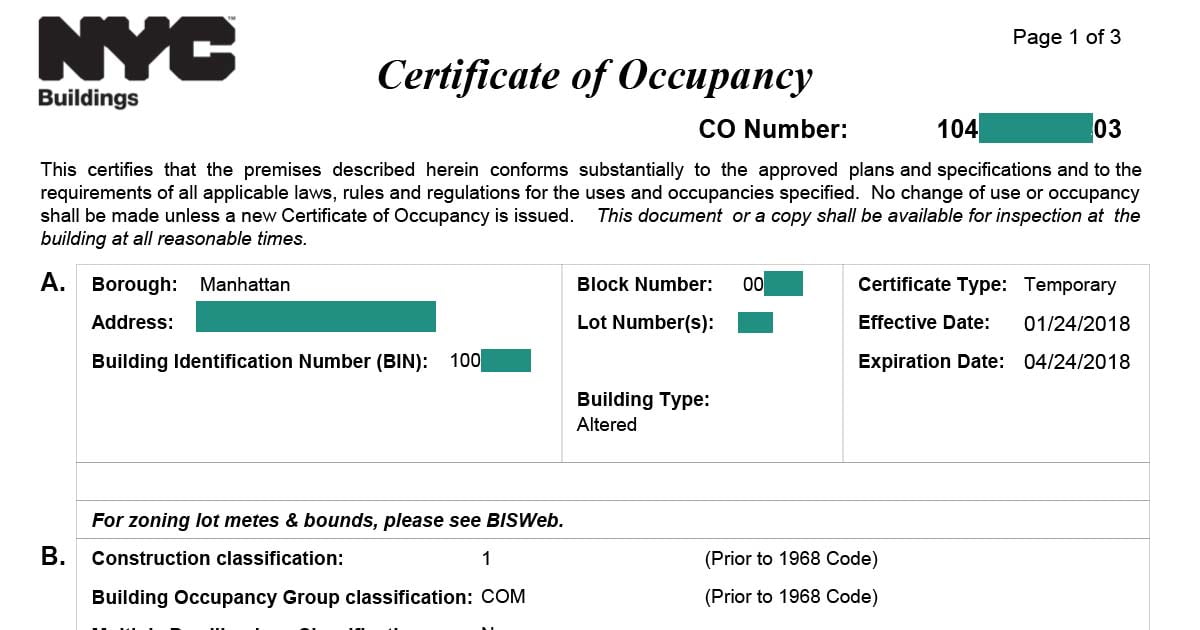
Certificate of Occupancy and TCO
A Certificate of Occupancy in NYC, commonly called a CO or C of O, is one of the most important records associated with a New York City building. It identifies the building’s legal use and/or permitted type of occupancy and can become extremely important when a property is sold, refinanced, renovated, converted, leased, or reviewed by the New York City Department of Buildings.
Many property owners do not pay much attention to the Certificate of Occupancy until a problem appears.
A buyer’s attorney may discover that the number of apartments does not match the building records. A commercial tenant may learn that the proposed business use is not consistent with the approved occupancy. An architect may discover during a renovation that the proposed work requires an amended Certificate of Occupancy. An owner may also discover that an older building has no Certificate of Occupancy at all.
These situations are common in New York City, particularly in buildings that have been altered many times over several decades.
Understanding what a Certificate of Occupancy is, how to look up a CO in NYC, when a new or amended CO is required, what a Temporary Certificate of Occupancy means, and what records to check when no CO exists is an important part of property due diligence.
What Is a Certificate of Occupancy in NYC?
A Certificate of Occupancy is an official record issued by the NYC Department of Buildings that states the legal use and/or permitted type of occupancy of a building.
According to the NYC Department of Buildings Certificate of Occupancy guidance, new buildings are required to have a Certificate of Occupancy. Existing buildings generally require a current or amended CO when there is a change in use, egress, or type of occupancy.
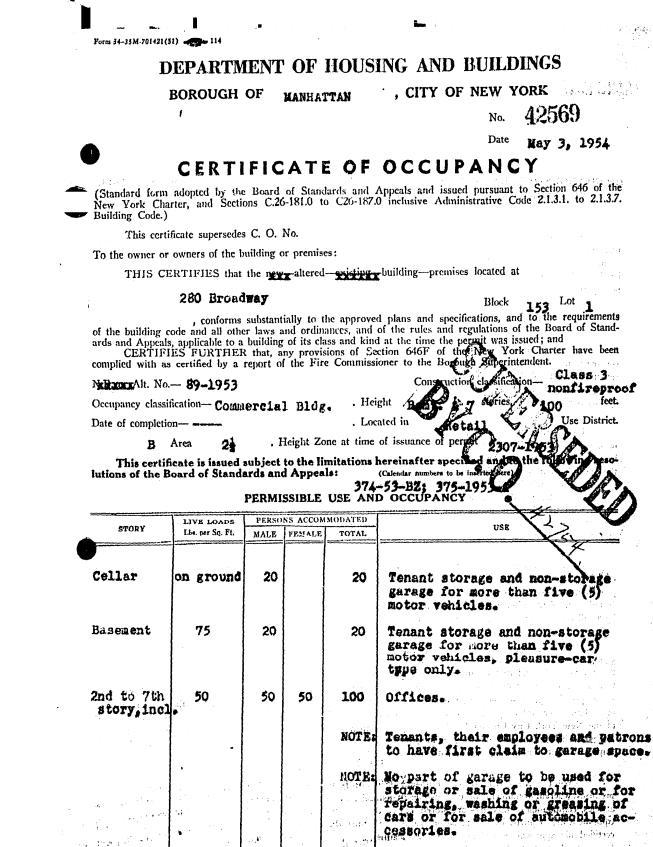
Depending on the age and format of the Certificate of Occupancy, it may provide information about:
Permitted use of individual floors
Residential or commercial occupancy
Number of dwelling units
Occupancy classifications
Cellar and basement uses
Accessory spaces
Public assembly spaces
Floor-by-floor occupancy
Other approved occupancy conditions
This means a building’s physical condition alone does not necessarily establish its legal occupancy.
For example, a building may physically contain three apartments. However, if the applicable Certificate of Occupancy and approved building records identify the property as a two-family dwelling, the existence of a third apartment does not automatically make that apartment legal.
The discrepancy should be investigated.
Why Does a Certificate of Occupancy Matter?
The Certificate of Occupancy matters because it helps establish how the City legally recognizes the use and occupancy of a building.
This information can affect many real estate and construction decisions, including:
Purchasing a property
Selling a property
Mortgage refinancing
Major renovations
Building additions
Changes in use
Commercial leasing
Adding dwelling units
Combining apartments
Converting buildings
Legalizing existing conditions
Filing new DOB applications
Consider a property marketed as a legal three-family house.
During due diligence, the buyer discovers that the Certificate of Occupancy recognizes only two dwelling units.
That discovery may raise several important questions:
Was the third apartment ever legally created?
Was an alteration application filed?
Were permits issued?
Were approved plans filed with DOB?
Were required inspections completed?
Was an amended Certificate of Occupancy required?
Are there open applications or permits?
Are there DOB violations related to the occupancy?
Can the existing condition be legalized?
This is why property owners and buyers should not simply ask:
“Does the building have a Certificate of Occupancy?”
A better question is:
“What is the legal occupancy of this property, and does the current building condition match the applicable City records?”
What Information Does a NYC Certificate of Occupancy Show?
A Certificate of Occupancy should generally be reviewed floor by floor.
For example, a mixed-use building may have occupancy records describing:
Cellar: Accessory storage and mechanical space
First Floor: Retail
Second Floor: Offices
Third through Fifth Floors: Residential apartments
The fact that residential use exists elsewhere in the building does not automatically authorize residential occupancy in the cellar.
Similarly, a commercial space cannot necessarily be used for any type of business simply because the CO identifies it as commercial space.
The specific use, occupancy classification, occupant load, means of egress, zoning regulations, accessibility requirements, fire-protection requirements, and other building-code provisions may also affect whether a proposed use is permitted.
For complicated properties, a proper review may involve much more than reading one Certificate of Occupancy.
How to Check a Certificate of Occupancy in NYC
One of the most common property-research questions is:
“How do I look up a Certificate of Occupancy in NYC?”
NYC Certificates of Occupancy are generally available through Department of Buildings public records.
Older Certificate of Occupancy Records
For Certificate of Occupancy requests made before March 1, 2021, DOB directs users to search through the Building Information System, commonly known as BIS.
Search the building address, access the Property Profile, and select the option to view Certificates of Occupancy.
Newer Certificate of Occupancy Records
For Certificate of Occupancy requests made on or after March 1, 2021, use the DOB NOW Public Portal.
Search by property address and review the Certificate of Occupancy section of the Property Profile.
The City’s current instructions are available through the NYC DOB Certificate of Occupancy page.
Do Not Review the CO in Isolation
For properties with complicated histories, particularly older New York City buildings, the Certificate of Occupancy should be reviewed together with other available records.
These may include:
Historical Certificates of Occupancy
BIS applications
DOB NOW applications
Approved plans
Schedule of Occupancy records
Open and closed permits
DOB violations
Historical alterations
Letters of No Objection
HPD records
HPD I-Cards
Other historical building records
A building may have been altered many times since its original construction. One document may not tell the entire story.
Does Every Building in NYC Have a Certificate of Occupancy?
No.
This is particularly important when researching older New York City properties.
According to NYC DOB, buildings constructed before 1938 are not required to have a Certificate of Occupancy unless later alterations changed their use, egress, or occupancy.
Therefore, the fact that you cannot locate a Certificate of Occupancy does not automatically mean the building is illegal.
Instead, you need to investigate the building’s history.
For certain qualifying older buildings without a CO, the Department of Buildings may issue a Letter of No Objection, commonly called an LNO, to confirm an accepted legal use.
For more information, see HN Republic’s guide:
What Is a DOB Letter of No Objection / Verification?
However, there is another historical record that can be particularly useful when researching older multifamily properties: the HPD I-Card.
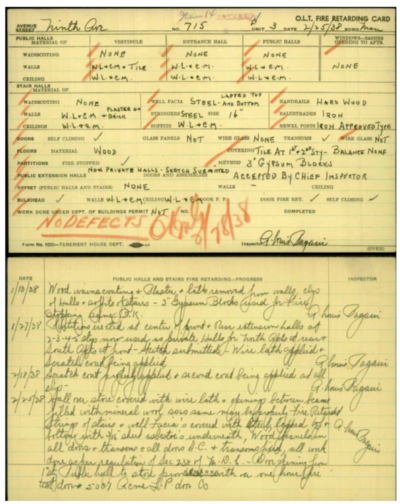
What Is an HPD I-Card, and Why Is It Important for Older NYC Buildings?
An HPD I-Card, historically known as an Improvement Card, is another important New York City building record that may help when researching the history and occupancy of older residential and multifamily buildings.
I-Cards originated during the early twentieth century in connection with enforcement of housing standards established under laws such as the Tenement House Act.
Historically, these records documented information about buildings and, in many cases, identified conditions or improvements needed to bring older tenement and multifamily properties into compliance with the housing and habitability standards applicable at the time.
I-Cards can contain valuable historical information concerning a building’s:
Arrangement
Residential occupancy
Number and type of units
Room configuration
Historical building conditions
Alterations or improvements
Housing classification
Inspection history
Because many older New York City multifamily buildings were constructed before modern Certificates of Occupancy were routinely required, an I-Card can become an important part of researching the building’s historical occupancy.
When Should You Check the HPD I-Card?
If you are researching an older multifamily building and cannot locate any Certificate of Occupancy in DOB records, checking HPD records should be one of the next steps.
For example, suppose you are reviewing a pre-1938 multifamily building and BIS does not show a Certificate of Occupancy.
You should not immediately conclude that:
“There is no CO, so the building has no legal residential occupancy.”
Instead, the investigation may include:
Reviewing DOB BIS records.
Reviewing DOB NOW records.
Checking historical applications and approved plans.
Reviewing the HPD I-Card, if one exists.
Checking later alteration applications.
Determining whether a later filing changed or superseded the historical occupancy.
Evaluating whether an LNO or another DOB process may be appropriate.
NYC DOB’s own records guidance states that HPD maintains an online database containing I-Card images for New York City properties.
You can search HPD records here:
Check a Building’s HPD I-Card through HPD Online
An I-Card Should Be Reviewed in Context
An important point is that an I-Card is a historical building record.
It should not automatically be assumed that every condition shown on an old I-Card represents the building’s current legal occupancy today.
A building may have undergone later alterations, conversions, apartment combinations, changes of use, or other work after the I-Card was created.
Later approved DOB applications or Certificates of Occupancy may therefore provide more recent occupancy information.
For this reason, an I-Card is most useful when reviewed together with the building’s complete DOB and HPD history.
For an older multifamily property with no CO, however, the I-Card can be an extremely valuable record and should not be overlooked.
When Is a New or Amended Certificate of Occupancy Required in NYC?
Not every renovation requires a new Certificate of Occupancy.
Interior renovation work, repairs, plumbing work, mechanical work, or other alterations may sometimes be completed without changing the building’s legal occupancy.
However, DOB requires a current or amended Certificate of Occupancy when an existing building undergoes a change in use, egress, or type of occupancy.
Projects that may involve an amended Certificate of Occupancy can include:
Converting commercial space to residential use
Changing residential space to commercial use
Increasing the number of dwelling units
Converting a one-family home to a two-family home
Major building additions
Certain occupancy-classification changes
Major alterations affecting means of egress
Other changes affecting legal occupancy
Whether a specific project requires an amended CO depends on the existing condition, proposed scope of work, zoning, applicable building code, occupancy classification, egress, approved plans, and property history.
Property owners should investigate these issues before construction begins.
What Is a Temporary Certificate of Occupancy in NYC?
A Temporary Certificate of Occupancy, commonly called a TCO, may be issued when the Department of Buildings determines that a building or applicable portion of a building may be occupied even though certain outstanding items remain before a final CO can be issued.
A TCO is not the same as a final Certificate of Occupancy.
According to the NYC Department of Buildings Temporary Certificate of Occupancy guidance, TCOs typically expire 90 days after issuance.
If the outstanding requirements for the final CO have not been resolved, the TCO may need to be renewed.
TCO vs. Final Certificate of Occupancy
The basic distinction is:
Temporary Certificate of Occupancy (TCO):
Allows temporary occupancy while certain outstanding final-CO requirements remain. A TCO has an expiration date.
Final Certificate of Occupancy:
Represents final occupancy approval associated with the applicable new-building or alteration process and does not simply expire after a fixed period.
Owners relying on a TCO should identify the outstanding requirements and work toward obtaining the final Certificate of Occupancy rather than treating temporary approval as permanent.
Does a Certificate of Occupancy Expire in NYC?
A final Certificate of Occupancy does not expire merely because time passes.
However, future work may require an amended Certificate of Occupancy.
For example, if an owner later changes the building’s use, egress, or type of occupancy, the existing CO may no longer be sufficient for the proposed condition.
A Temporary Certificate of Occupancy is different. A TCO has an expiration date and typically expires 90 days after issuance.
What Can Prevent a Final Certificate of Occupancy From Being Issued?
Completing the physical construction is not necessarily enough to obtain a final CO.
Depending on the project, outstanding requirements may include:
Construction inspection sign-off
Plumbing inspection sign-off
Electrical inspection sign-off
Elevator sign-off
Required technical reports
Approved Schedule of Occupancy
Required agency approvals
Resolution of relevant violations
Outstanding fees
Required project documents
Completion of applicable DOB administrative requirements
The exact requirements vary by project.
This is one reason some buildings remain on a Temporary Certificate of Occupancy for extended periods or why a completed construction project may still have an open DOB application.
If your property has unresolved permits or applications, see:
How to Close an Open DOB Permit in NYC and Get Sign-Off
For alteration projects that do not require a new or amended Certificate of Occupancy, DOB may instead issue a Letter of Completion after applicable closeout requirements are satisfied. You can learn more in HN Republic’s separate guide:
How to Obtain a DOB Letter of Completion in NYC
What Happens If the Building Does Not Match Its Certificate of Occupancy?
A discrepancy between current conditions and the Certificate of Occupancy should be investigated carefully.
Possible situations include:
Work was legally filed but never properly closed.
Construction was completed without the required permit.
An additional dwelling unit was created.
The building’s use changed.
The existing layout differs from the approved plans.
A later alteration was approved but the records need further review.
An amended Certificate of Occupancy may be required.
Existing conditions may need to be legalized or restored.
There is no single solution that applies to every building.
Before filing anything with DOB, it is important to understand the property history and determine exactly what condition must be corrected or documented.
Can You Buy or Sell a Property Without a Certificate of Occupancy in NYC?
The answer depends on the building.
A pre-1938 building may legitimately have no Certificate of Occupancy because one was never required.
Another building may lack a final CO because a major alteration was never completed or signed off.
Those are very different situations.
When researching a property without a CO, relevant documents may include:
DOB historical records
Approved plans
Old applications
HPD I-Cards
Letters of No Objection
Historical permits
Later alteration filings
For buyers and sellers, the more important question is not simply whether a CO exists.
The real question is:
What City records establish the property’s legal occupancy, and does the building’s present condition agree with those records?
Frequently Asked Questions About Certificate of Occupancy in NYC
How do I find a Certificate of Occupancy for a NYC property?
Search the building through NYC DOB’s BIS system and DOB NOW Public Portal. Older Certificates of Occupancy are generally found through BIS, while newer CO records are available through DOB NOW.
Does every NYC building need a Certificate of Occupancy?
No. Buildings constructed before 1938 may not be required to have a CO unless subsequent work changed use, egress, or occupancy.
What should I check if an old multifamily building has no CO?
Review DOB records, historical applications, approved plans, and HPD records. If an HPD I-Card exists, it may provide important information regarding the building’s historical arrangement and occupancy.
Where can I find an HPD I-Card?
Search the property through HPD Online. HPD maintains I-Card images for many older New York City properties.
Does an HPD I-Card replace a Certificate of Occupancy?
Not generally. An I-Card is a historical record that may provide important occupancy information, particularly for older buildings without a CO. Later approved DOB filings or Certificates of Occupancy may supersede information shown on an older I-Card.
What is a TCO in NYC?
A Temporary Certificate of Occupancy allows temporary occupancy when DOB determines that the applicable space may be occupied while certain outstanding requirements for the final CO remain.
How long does a TCO last in NYC?
NYC DOB states that TCOs typically expire 90 days after issuance.
Does a final Certificate of Occupancy expire?
A final Certificate of Occupancy does not have a routine expiration date simply because time passes. Future alterations affecting use, egress, or occupancy may nevertheless require an amended CO.
What happens if my building does not match its CO?
The discrepancy should be evaluated by reviewing existing conditions, DOB applications, approved plans, zoning, applicable code requirements, and historical records. Depending on the circumstances, legalization, an amended filing, project closeout, or restoration may be required.
Final Thoughts
A Certificate of Occupancy in NYC is much more than another document in the DOB database. It is one of the primary records used to understand a building’s legal use and permitted occupancy.
For newer properties, the occupancy history may be relatively straightforward.
For older New York City buildings, especially multifamily properties, determining legal occupancy can require more investigation. A building may have no Certificate of Occupancy but still have important historical evidence in approved plans, DOB applications, a Letter of No Objection, or an HPD I-Card.
That is why a proper Certificate of Occupancy review should consider the entire regulatory history of the property rather than one isolated document.
Before purchasing, selling, renovating, converting, or legalizing a building, property owners should understand:
What the current Certificate of Occupancy permits
Whether a Certificate of Occupancy was required
What historical DOB and HPD records show
Whether current conditions match approved records
Whether proposed work requires an amended CO
Whether outstanding applications or violations need to be resolved
Identifying these issues early can prevent them from becoming major obstacles during a closing, permit filing, renovation, or change of use.
HN Republic provides NYC architecture, zoning consulting, DOB filing, expediting, property-record research, permit closeout, and Certificate of Occupancy support for property owners, developers, contractors, and real-estate professionals throughout New York City.
Disclaimer: This article is intended for general educational and informational purposes only. Building occupancy requirements depend on the specific property, filing history, approved plans, existing conditions, applicable building code, zoning regulations, and other factors. Property-specific legal questions should be reviewed with the appropriate legal professional.