Floor Area Ratio (FAR) in Zoning Analysis
FAR stands for Floor Area Ratio. It is one of the main zoning measurements used to control the amount of floor area permitted on a zoning lot.
A simple FAR calculation can provide an early estimate of a property’s development potential. However, FAR does not tell you everything you need to know. Height limits, yards, setbacks, lot coverage, permitted use, special-district regulations, and other rules can affect how much of that potential can actually be built.
This guide explains how Floor Area Ratio works in NYC, how to calculate it, and why a complete zoning analysis should happen before a project moves too far into design.
What Is Floor Area Ratio in NYC Zoning?
The NYC Zoning Resolution defines Floor Area Ratio as the total zoning floor area on a zoning lot divided by the area of that zoning lot.
In everyday language, FAR is the property’s zoning square-footage budget.
The basic formula is:
FAR = Total zoning floor area ÷ Zoning lot area
When you already know the maximum permitted FAR, you can reverse the formula:
Maximum permitted zoning floor area = Zoning lot area × Maximum FAR
For example, imagine a property with:
A 2,000-square-foot zoning lot
A maximum permitted FAR of 2.0
The calculation would be:
2,000 square feet × 2.0 FAR = 4,000 square feet
The property may therefore permit up to 4,000 square feet of zoning floor area, subject to all other applicable regulations.
The word “may” is important. This calculation establishes a floor-area limit, but it does not approve a particular building design.
Watch: How Floor Area Ratio Works in NYC
[Keep the existing YouTube video embedded here]
This video provides a visual explanation of FAR, including how the same amount of floor area can be arranged in different building forms.
One FAR, Several Possible Building Shapes
FAR controls the total amount of zoning floor area—not the exact number of stories.
Using the previous example, 4,000 square feet of floor area could theoretically be arranged as:
Two floors containing 2,000 square feet each
Four floors containing 1,000 square feet each
Five floors containing 800 square feet each
Each option totals 4,000 square feet and produces the same FAR.
That does not mean all three designs are legal. One configuration may conflict with height, setback, yard, street-wall, lot-coverage, or other bulk regulations.
This is why FAR should be treated as an early feasibility measurement, not as a complete design approval.
FAR Is Not the Same as Building Height
One of the most common misunderstandings is that an FAR of 2.0 means a building can have two stories.
It does not.
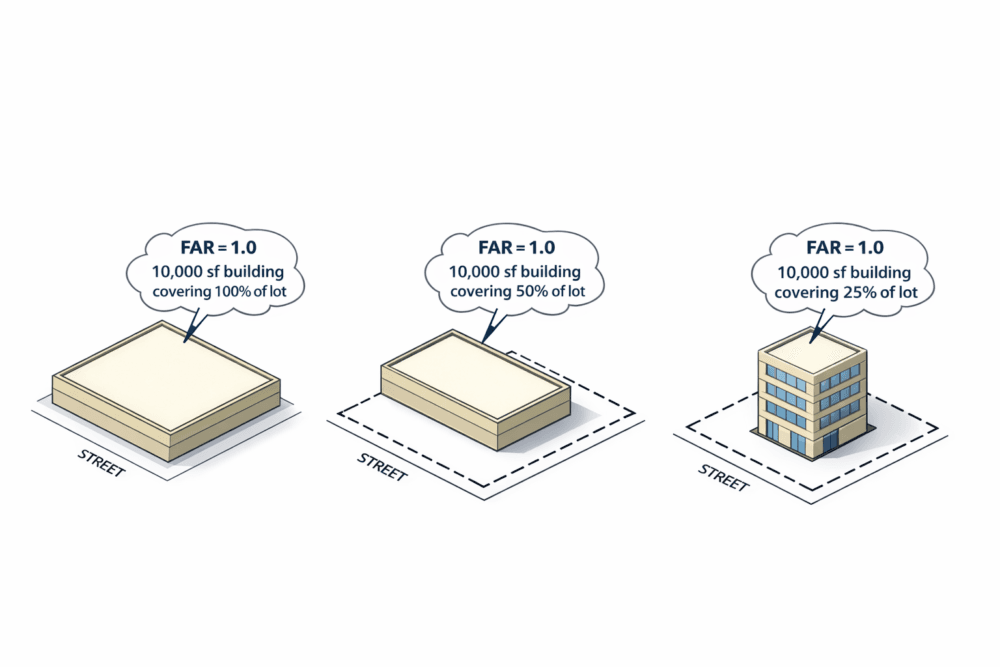
A two-story building covering the entire lot could produce an FAR of 2.0, but so could a four-story building covering approximately half of the lot. Whether either building is permitted depends on the regulations that shape the building envelope.
FAR does not independently determine:
The maximum building height
The permitted number of stories
Required front, side, or rear yards
Maximum lot coverage
Base-height or setback requirements
Street-wall requirements
Sky-exposure-plane requirements
The number of dwelling units
Whether the proposed use is permitted
FAR answers one important question: How much zoning floor area may be allowed?
The remaining zoning rules answer another: Can that floor area fit inside a compliant building?
FAR Is Also Different From Lot Coverage
FAR and lot coverage both affect building size, but they measure different things.
FAR compares the building’s total zoning floor area with the area of the zoning lot.
Lot coverage measures how much of the lot is covered by the building at a particular level, generally expressed as a percentage.
A 10,000-square-foot lot with a 5,000-square-foot building footprint has 50% lot coverage. If that footprint continues for four equal floors, the building contains 20,000 square feet and has an FAR of 2.0.
This distinction explains how buildings with the same FAR can have very different heights and footprints.
Zoning Floor Area Is Not Always Gross Building Area
Another common mistake is using the building’s gross square footage as its zoning floor area.
NYC zoning has a specific definition of “floor area.” Certain spaces may be included, excluded, or treated differently depending on their location, use, building type, and the applicable regulations.
For example, the rules may address:
Cellar space
Mechanical and equipment areas
Stair and elevator spaces
Exterior-wall thickness
Parking areas
Balconies and unenclosed spaces
Certain building amenities
Energy-related floor-area deductions
A space described as a “basement” in a real-estate listing is not automatically excluded from FAR. Under NYC zoning, the difference between a basement and a cellar depends partly on how the space sits in relation to the curb level or base plane. A qualifying cellar is generally excluded from zoning floor area unless it is used for dwelling purposes.
Because these definitions are detailed and property-specific, floor-area calculations should be based on the current Zoning Resolution—not simply on a listing, tax record, or gross-building-area figure.
How to Calculate a Property’s Existing FAR
To estimate the FAR already used by an existing building, use this formula:
Existing FAR = Existing zoning floor area ÷ Zoning lot area
For example:
Zoning lot area: 2,000 square feet
Existing zoning floor area: 2,500 square feet
2,500 ÷ 2,000 = 1.25 existing FAR
If the property’s maximum permitted FAR is 2.0, an early calculation might show:
Maximum floor area: 2,000 × 2.0 = 4,000 square feet
Existing floor area: 2,500 square feet
Potential unused floor area: 4,000 − 2,500 = 1,500 square feet
That 1,500 square feet represents theoretical unused development potential. It does not prove that a 1,500-square-foot enlargement is feasible.
The building envelope, existing conditions, zoning-lot history, structural limitations, use, and applicable regulations must still be reviewed.
What Is Unused FAR or “Air Rights”?
When a building uses less floor area than zoning permits, the difference is commonly called unused FAR, unused development rights, or “air rights.”
Unused development rights may add value to a property, but their existence does not automatically mean they can be:
Used in an enlargement
Sold independently
Transferred to another property
Added to any neighboring development
Transfers and zoning-lot mergers must satisfy specific legal and zoning requirements. Special rules can also apply to landmark properties and sites in special-purpose districts.
A zoning and title review is usually necessary before relying on transferable development rights in a purchase, sale, or development plan.
How to Find the FAR for an NYC Property
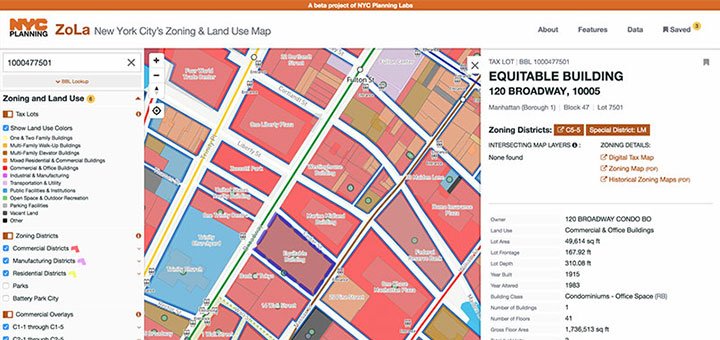
The NYC Planning ZoLa map is a useful starting point for researching a property.
Enter the street address or block and lot number, then review:
The mapped zoning district
Identify the residential, commercial, or manufacturing district affecting the property.Commercial overlays
An overlay may affect permitted commercial uses and other requirements.Special-purpose districts
Special-district rules can modify the regulations of the underlying zoning district.Coastal, transit, or other mapped conditions
Additional regulations may apply depending on the property’s location.The zoning-district information
Follow the district link and review the current regulations for the proposed use.
ZoLa is an excellent research tool, but it should not be the only source used for a real project. The zoning lot may differ from the tax lot, and district-boundary lines, prior zoning-lot mergers, restrictive declarations, or special regulations may change the analysis.
Why the Permitted FAR May Depend on the Proposed Use
A zoning district does not always provide one universal FAR for every project.
The permitted floor area can depend on whether the proposed space will contain:
Residential use
Commercial use
Manufacturing use
Community-facility use
A mixed-use building
Qualifying affordable or senior housing
A use eligible for a zoning incentive or floor-area bonus
Mixed-use buildings may require separate floor-area calculations for different portions of the building. Special districts and affordability programs may also modify the base regulations.
For that reason, it is risky to take a single FAR number from a property-data website and apply it to every possible project.
Why Available FAR May Be Impossible to Use
A property can have unused FAR on paper but still lack enough room for a legal enlargement.
Consider a 2,000-square-foot lot where the zoning calculation permits 4,000 square feet. The proposed building may still be limited by:
A required rear yard
Maximum lot coverage
A maximum base or building height
Required setbacks
A sky exposure plane
Street-wall rules
Existing noncomplying conditions
A narrow or irregular lot
Multiple zoning districts crossing the lot
Building-code, egress, accessibility, or structural constraints
The remaining FAR may be real, but the available building envelope may be too small to accommodate all of it.
A proper feasibility study therefore combines floor-area calculations, building-envelope analysis, proposed use, existing conditions, and applicable code requirements.
Why FAR Matters Before a DOB Filing
FAR calculations are typically shown as part of a project’s zoning analysis and filing documents.
If the proposed plans exceed the permitted floor area—or if the calculation uses the wrong lot area, FAR, or floor-area deductions—the project may receive objections during Department of Buildings review.
That can lead to:
Drawing revisions
Changes to the proposed layout
Reduced project area
Additional research or documentation
Delays during plan examination
Changes to construction pricing
Problems legalizing existing work
An early NYC zoning and building-code review can identify these issues before significant time and money are committed to design.
Once the project scope is confirmed, coordinated architectural plans and DOB filing documents can help keep the zoning calculations, drawings, and application information consistent.
A Practical FAR Checklist for Property Owners
Before purchasing, enlarging, or redeveloping a property, confirm:
The tax lot and zoning-lot boundaries
The official lot area
Every zoning district affecting the site
Commercial overlays and special-purpose districts
The proposed use or mix of uses
The applicable maximum FAR
Existing zoning floor area
Potential floor-area exclusions
Unused development rights
Height, setback, yard, and lot-coverage rules
Existing nonconforming or noncomplying conditions
Prior zoning-lot mergers or recorded restrictions
The likely DOB filing path
This review provides a more realistic answer than multiplying one FAR number by the lot area.
Frequently Asked Questions About FAR in NYC
What does FAR stand for in NYC zoning?
FAR stands for Floor Area Ratio. It compares the total zoning floor area on a zoning lot with the area of that lot.
What is the formula for calculating FAR?
Divide the total zoning floor area by the zoning lot area:
FAR = Zoning floor area ÷ Zoning lot area
To estimate the maximum permitted floor area, multiply the lot area by the allowed FAR.
How many floors can I build with an FAR of 2.0?
FAR alone does not determine the number of floors. An FAR of 2.0 could describe a two-story building covering most of the lot or a taller building with a smaller footprint. Height, yards, setbacks, and lot coverage determine which configuration is legal.
Does a basement count toward FAR in NYC?
A basement will often count toward zoning floor area, while a qualifying zoning cellar is generally excluded unless it is used for dwelling purposes. The classification depends on the space’s relationship to the applicable curb level or base plane and other conditions.
Is FAR the same as lot coverage?
No. FAR measures total zoning floor area in relation to lot area. Lot coverage measures the portion of the lot occupied by the building footprint.
Where can I check a property’s FAR?
Start with NYC Planning’s ZoLa map to identify the zoning district, overlays, and special districts. Then verify the applicable rules in the current NYC Zoning Resolution.
Can I use all of my available FAR?
Not always. The legal building envelope, existing conditions, height, yards, setbacks, lot coverage, and other regulations may prevent a project from using all theoretically available floor area.
Can unused FAR be transferred to another property?
Sometimes, but only when the properties and proposed transfer satisfy the applicable zoning and legal requirements. The existence of unused FAR does not automatically make it transferable.
What happens if a design exceeds the permitted FAR?
DOB may issue objections and require the plans or calculations to be revised. Unresolved excess floor area can also complicate future permits, legalization, financing, or a property transaction.
Understand the Property Before You Design
Floor Area Ratio is one of the most useful starting points in an NYC zoning analysis. It estimates the amount of floor area zoning may allow, but it does not establish the complete size or shape of a legal building.
Before relying on an FAR calculation for a purchase, renovation, addition, or new development, review the zoning lot, proposed use, building envelope, existing records, and current regulations together.
HN Republic provides NYC zoning and building-code consulting and DOB filing coordination for property owners and project teams. To request a project-specific review, send the property address, proposed scope, and any available survey, plans, or DOB records through the HN Republic contact page.
This article provides general educational information. Zoning conclusions depend on the facts, records, proposed use, and regulations applicable to each property. Agency approval and development potential should be confirmed by the appropriate qualified professionals.